Science and innovation
Xiaomi's humanoid robot reaches 98% accuracy in car factory
After four months of testing, Xiaomi's humanoid raised the success rate in a car assembly stage from 90.2% to 98%. The result is promising, but still leaves doubts about autonomy, human interventions and operation at scale.
By Ederson Andrade · August 29, 2026 · 6 min read
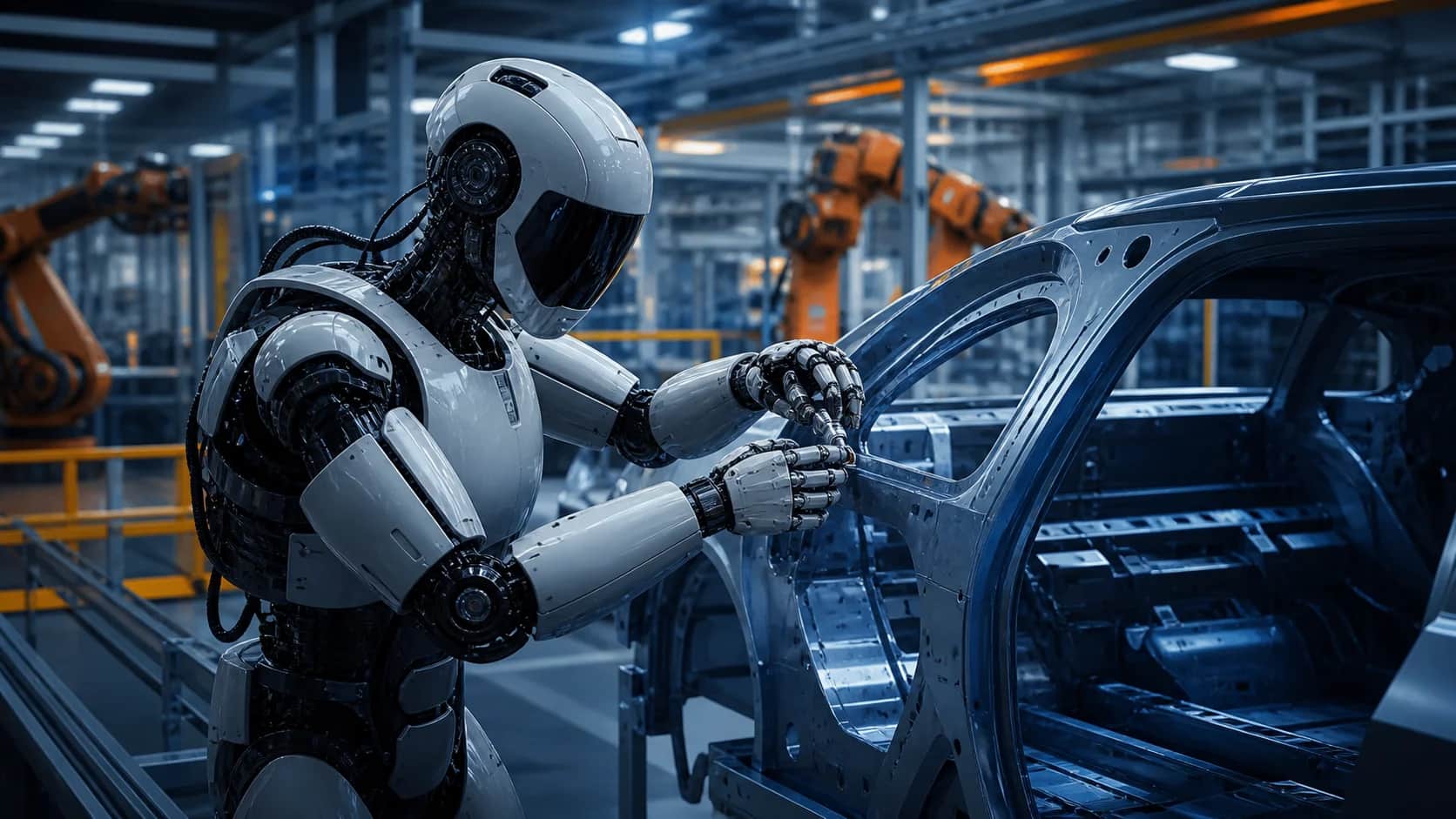
A humanoid robot from Xiaomi spent four months working as an "intern" in an electric car factory. According to the company, the machine rose from 90.2% to 98% its success rate in an assembly step that requires positioning and fixing nuts to the body.
The advance draws attention, but needs to be read carefully. The 98% does not represent a general accuracy of the robot in any activity. The number refers to a specific task, under conditions defined by Xiaomi, and has not yet been validated by an independent audit.
What happened at the factory
Xiaomi reported that its humanoid reached a 98% success rate in a self-tapping sow placement station. The result was one percentage point below the criteria assigned by the company to experienced human operators.
The robot also began to perform two new activities: organizing flexible parts on the side of the center console and folding returnable boxes used in logistics. According to data released by the company and reported by eWeek, the two tasks exceeded 90% success.
The test is important because it takes the robot beyond a short, controlled demonstration. It needs to perceive parts, align its hands, apply force, follow the pace of the line, and react to small differences between one item and another.
Still, Xiaomi has not published enough information to conclude that the technology is ready to work on its own during full shifts. Data on the total number of cycles, frequency of human help, recovery time after a failure, maintenance, and performance of multiple robots at the same time is lacking.
Xiaomi's humanoid timeline
2022: The debut of CyberOne
The public story began in August 2022, when Xiaomi presented the CyberOne, a bipedal human-sized robot. At the time, the project was able to balance the body, perceive depth, and recognize elements of the environment. It was, above all, a demonstration of research and engineering.
CyberOne made it clear that Xiaomi wanted to go beyond mobile phones, connected homes, and cars. But there was still a long way between walking on a stage and performing a useful task inside a factory.
February 2026: the Xiaomi-Robotics-0
In February 2026, the company opened the Xiaomi-Robotics-0, a model of vision, language, and action with 4.7 billion parameters. This type of system receives images and instructions, interprets what is in front of the robot, and transforms this understanding into movements.
Xiaomi claims that the model was trained with about 200 million steps of robotic trajectories and more than 80 million vision and language samples. The project was also designed to perform actions continuously, without having to interrupt the movement while calculating the entire next step.
That doesn't prove, by itself, that Robotics-0 is exactly the entire system used in the industrial test. But it does show the foundation of embedded intelligence that the company was developing when it decided to put robots in the vehicle lineup.
March 2026: Three hours and 90.2% success rate
In the official 2025 earnings report, published in March 2026, Xiaomi recorded a statement of three consecutive hours at its electric car factory. The robots worked autonomously at the sow placing station, achieved 90.2% success and followed the line's shortest cycle time of 76 seconds.
At that time, the company itself treated the work as a first step to expand the use of embedded intelligence in automotive production.
July 2026: the jump to 98%
After approximately four months of adjustments in software, perception and control, the reported rate rose to 98%. The robot also started to handle tasks that require coordination between the two arms and contact with less rigid materials.
In the same period, Xiaomi presented the Xiaomi-Robotics-1. According to the project's official page, the new model was pre-trained with more than 100,000 hours of manipulation trajectories spread over more than 1,700 scenarios. The company also used more than 7,200 hours of data collected with real robots in homes during the later training stage.
These numbers help you understand the strategy: increase the variety of experiences of the model so that it learns new tasks with fewer specific demonstrations.
Why use a robot with a human form?
Traditional industrial arms excel at repetitive, well-defined tasks. They can work with a lot of speed and precision, but typically rely on a station designed for that role.
The argument in favor of humanoids is different. Factories, tools, corridors, and workbenches have already been organized for the human body. A robot with two arms, hands, and a height similar to ours could circulate in this space and change activity without requiring a complete overhaul of the line.
This flexibility will only have real value if it is accompanied by reliability, safety, and competitive cost. To always tighten the same part, a specialized machine can still be the simplest solution. The humanoid begins to make sense when it can take on varied activities and adapt to changes without a long reprogramming.
What 98% Really Means
In a simple reading, 98% is equivalent to two unsuccessful attempts out of every hundred. In industry, however, the severity of a failure depends on what happens next. Does the system notice the error? Does it try again on its own? Does it interrupt the line? Need to call a person? Can it damage a part?
We also don't know the size of the sample used in the most recent result. A rate obtained in hundreds of cycles does not offer the same confidence as one maintained for weeks, in different shifts, and with several robots.
So the best summary is this: 98% represents a relevant evolution in a specific task, not proof that an entire factory can already be operated by humanoids.
Does this mean immediate replacement of workers?
No. During the first tests, Xiaomi's president, Lu Weibing, compared the robots to interns who were still learning. The company did not present a schedule for replacing teams or demonstrate autonomous operation on an industrial scale.
Nor does this eliminate the debate about work. If technology matures, some roles may change, while others must emerge in oversight, security, maintenance, integration, and training of systems. The impact will depend less on a stand-alone demonstration and more on cost, reliability, and speed of adoption over the next few years.
What to follow now
The next results will be more important if they bring metrics that are still absent today:
- duration of full shifts;
- number of cycles and sample size;
- number of human interventions;
- ability to recognize and correct mistakes;
- safety when working close to people;
- energy, maintenance and operation costs;
- quick switching between different tasks;
- simultaneous performance of multiple robots.
Until then, Xiaomi's humanoid should be seen as a Promising industrial experiment. It has already come a considerable distance since the CyberOne introduced in 2022, but it has yet to prove that it can turn a good success rate into reliable, ongoing, and economically viable work.