Science and innovation
How electricity and AI can help search for life beyond Earth
A gold sensor reads amino acids molecule by molecule. Understand the search for biosignatures, the role of AI, and why the method still doesn't prove life beyond Earth.
By Ederson Andrade · October 13, 2026 · 5 min read
If a lab finds amino acids in a meteorite, does that mean there was life outside Earth? No. These molecules can also form without organisms. A more interesting clue is to observe which Amino acids appear, in what quantities and if their molecules favor one of two forms that resemble images in the mirror.
It was to measure part of this chemical history that a team led by Osaka University developed a single-molecule electrical sensor. Published on October 5, 2026, the study combines electrodes separated by less than a nanometer and machine learning to distinguish forms of amino acids. It is a breakthrough of chemical analysis in the laboratory, Not the discovery of extraterrestrial life.
Why does the "hand" of a molecule matter?
Think of two gloves: the right and the left have the same parts, but one doesn't fit into the other if you just spin it. Many amino acids also have two mirrored versions, called L e D. The property is named after chirality. Glycine is an important exception among the amino acids used to form proteins: it does not have this L/D distinction.
Terrestrial life predominantly uses L-amino acids to build proteins. Chemical processes without the participation of life often produce mixtures close to half L and half D. Therefore, a large difference between the quantities of the two forms can be a Possible biosignature, a chemical signal that deserves investigation. O NASA's Jet Propulsion Laboratory He also recommends looking at the type and relative abundance of these molecules, because amino acids appear even where there is no life.
This rule is not infallible. Meteorite studies documented by NASA show that non-biological processes can generate excess in one way. And when a sample reaches Earth, contamination by terrestrial compounds also needs to be ruled out. An isolated L/D imbalance would not prove life on Mars or another world.
How the sensor turns molecules into electrical signals
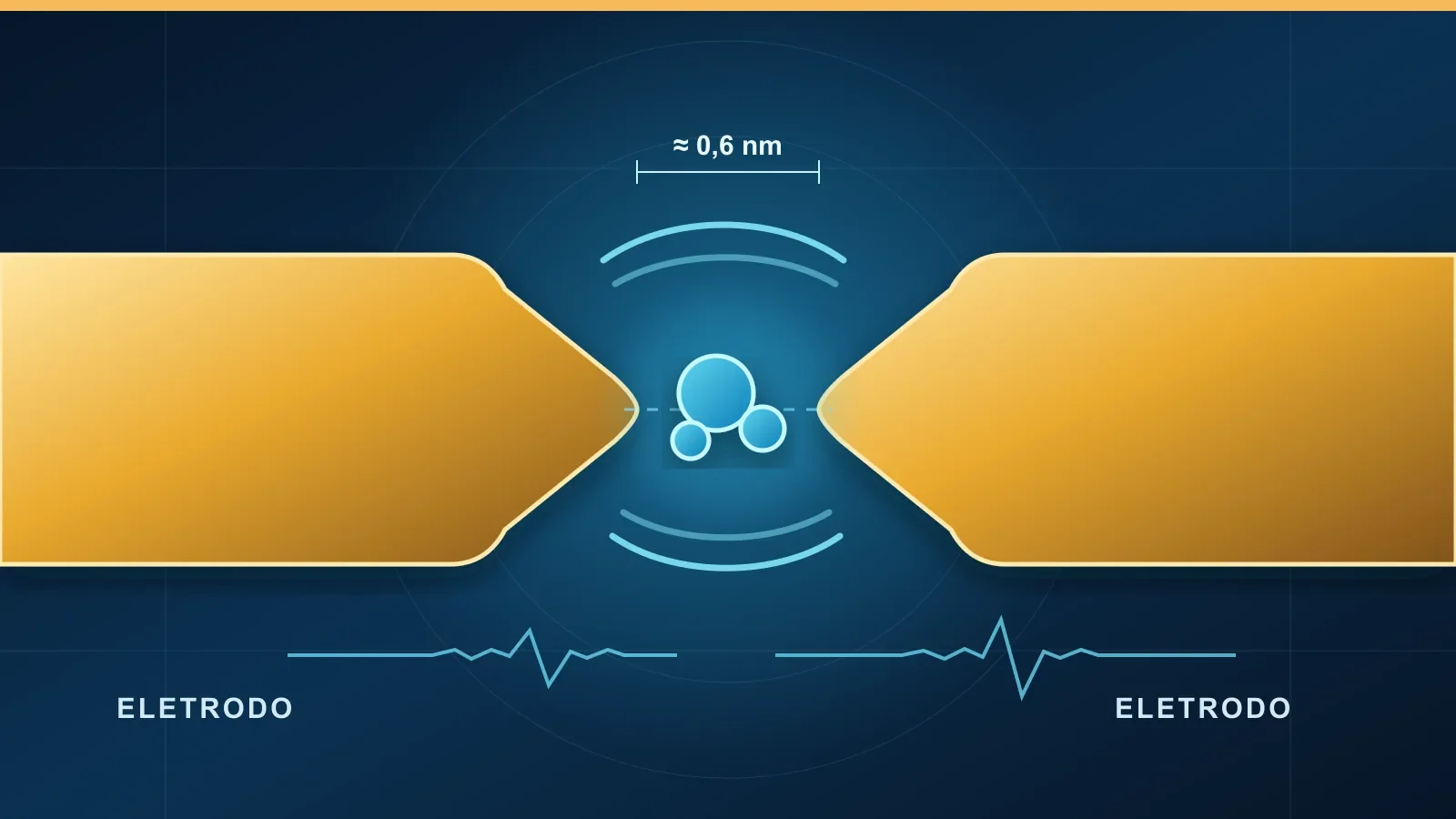
The study device has two gold points separated by a space of about 0.56 to 0.58 nm. When an amino acid molecule passes through this range, it briefly alters the electric current that crosses the small gap by a quantum effect called Tunneling. The result is a pulse: a curve that shows how the current has varied over time.
The researchers measured curves of known samples and trained machine learning classifiers to recognize patterns. The AI therefore Classifies electrical signals; It doesn't observe an organism or decide on its own whether a sample contains life. The team wants the shape of the pulse to help answer three questions: which molecule passed through the sensor, whether it was L or D, and how many occurrences of each were observed.
O Scientific article reports different results depending on the difficulty of the task. To distinguish the two forms of amino acids individually, the accuracy surpassed 80%. In a more demanding blind test, which I needed to recognize at the same time the identity and chirality between 39 classes "19 amino acids with L and D forms, plus glycine," the agreement was Above 50%. In controlled mixtures of four amino acids, the composition estimate exceeded 66% accuracy. None of these numbers means "80% certainty of finding life."
Why test a meteorite and the Atacama Desert?
Solutions prepared with known molecules are a first step, but natural materials contain many mixed substances. The team also analyzed extracts from the Murchison meteorite, rich in organic compounds of extraterrestrial origin, and soils of the Atacama, a Chilean region used as an analogue of Martian environments. These materials were examined in a laboratory on Earth.
On these samples, the researchers worked with a targeted panel of 11 amino acids and compared the results with a conventional laboratory technique of chromatography and mass spectrometry, known as LC–MS. The electrical method captured important characteristics of the composition, but the quantity estimates and some ratios between D and L diverged depending on the molecule and sample. Own Osaka University statement recognizes that accuracy in complex materials still needs to improve.
The meteorite demonstrates that the device can work with material that contains molecules from space; it does not mean that it has found life in it. The Atacama tests the technique in difficult soil and similar to certain conditions on Mars; it does not replace a measurement made on Mars.
What is missing to use this in a space mission?
A compact electrical sensor can be attractive to probes, which have size, mass, and energy limits. The proposed reading does not depend on large optics or special molecules to recognize chirality in the sensor itself. Still, The study samples were extracted and prepared in the laboratory; It is not a matter of putting raw earth in the device and receiving an automatic diagnosis.
Before a space application, it will be necessary to verify accuracy with unknown mixtures, separate background signals, avoid contamination, improve the measurement of L/D ratios, and prove that the instrument supports the conditions of a mission. Even then, an unequal ratio would be only one piece of the puzzle. The scientific way is to put together molecule type, distribution, geological context, and other independent measurements before sustaining a hypothesis of life.
The value of research lies in making an abstract question, "Are there signs of life?", more measurable: What molecules did we find, and what story does your organization tell? The new technique has yet to mature, but it adds an electric way to investigate this history, molecule by molecule.