Science and innovation
The world's largest particle accelerator has stopped. Now CERN is preparing an even more powerful version
The LHC went on a four-year hiatus to become HiLumi. Here's what changes in the beams, magnets, and detectors, and why it matters to physics.
By Ederson Andrade · October 8, 2026 · 8 min read
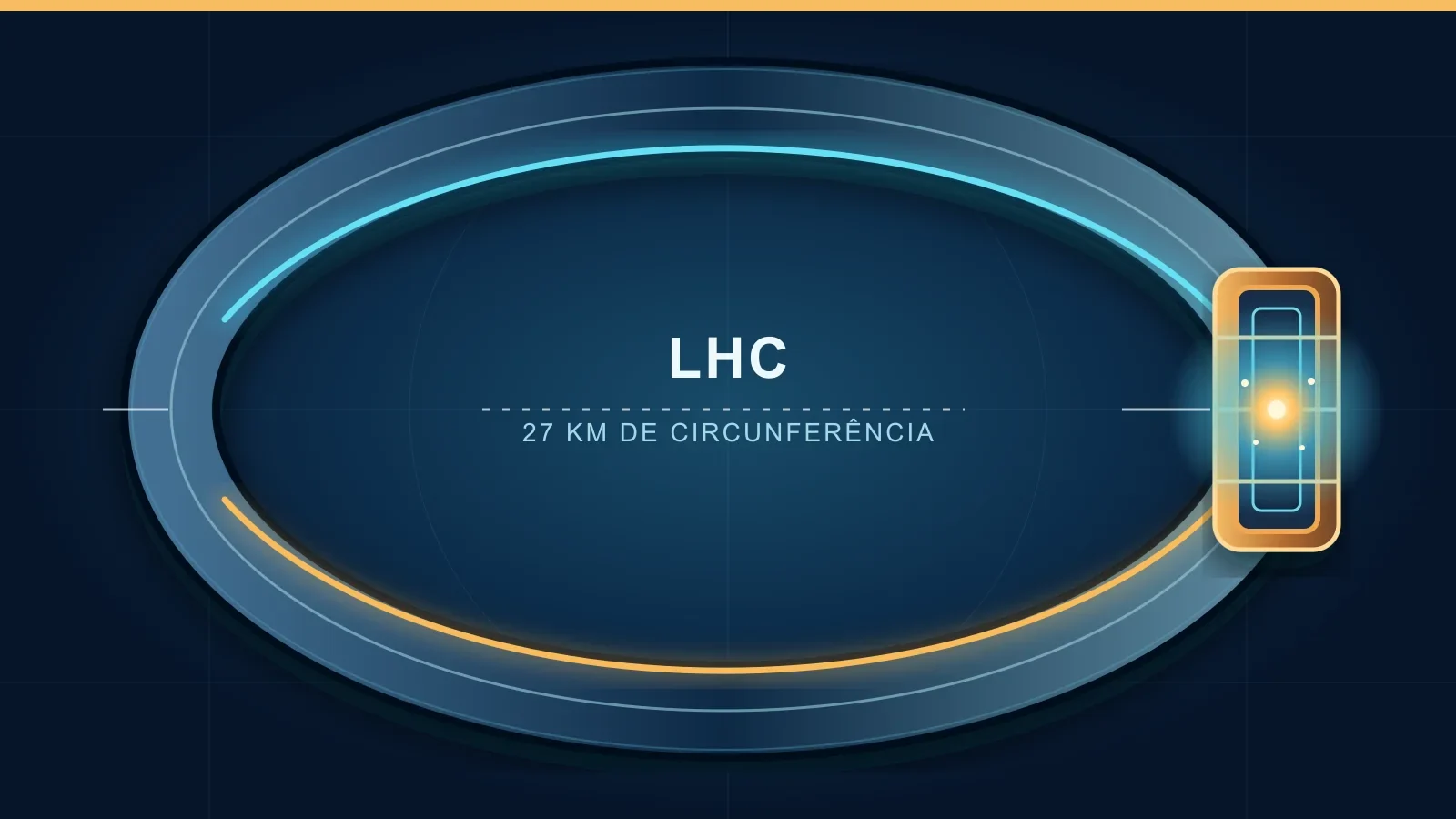
The world's largest particle accelerator is out of beams, but its tunnels are not empty. O Large Hadron Collider (LHC) has come to a scheduled halt to receive new magnets, power supply systems and detectors. The renovation should last about four years. If the schedule holds, the machine will return in 2030 as High-Luminosity LHC, or HiLumi LHC.
The name may suggest an entirely new accelerator. The transformation, however, occurs in the 27-kilometer ring that already exists. Its main goal is not to multiply by ten the speed of the protons, which already circulate close to the speed of light. It is to make the beams produce more usable collisions, so that the experiments have enough data to see rare phenomena.
When did the LHC stop, and what is still happening?
There are three different dates in this story. The experiments ATLAS, CMS, ALICE and LHCb received their Last collisions intended for physics on June 14, 2026. For the next two weeks, operators still used beams to test the machine in conditions close to those planned for the HiLumi. The Last beams were removed on June 27. In June 29, CERN formally handed over the accelerator to the teams responsible for the Long Shutdown 3, or LS3, the third major technical stop.
Stopping the collisions does not stop the research. The experiments continue to analyze the data already collected, while engineers work on the accelerator and the surrounding facilities. CERN plans to retire and replace components in approximately 1.2 km from the ring, in addition to modernizing mainly the ATLAS and CMS detectors.
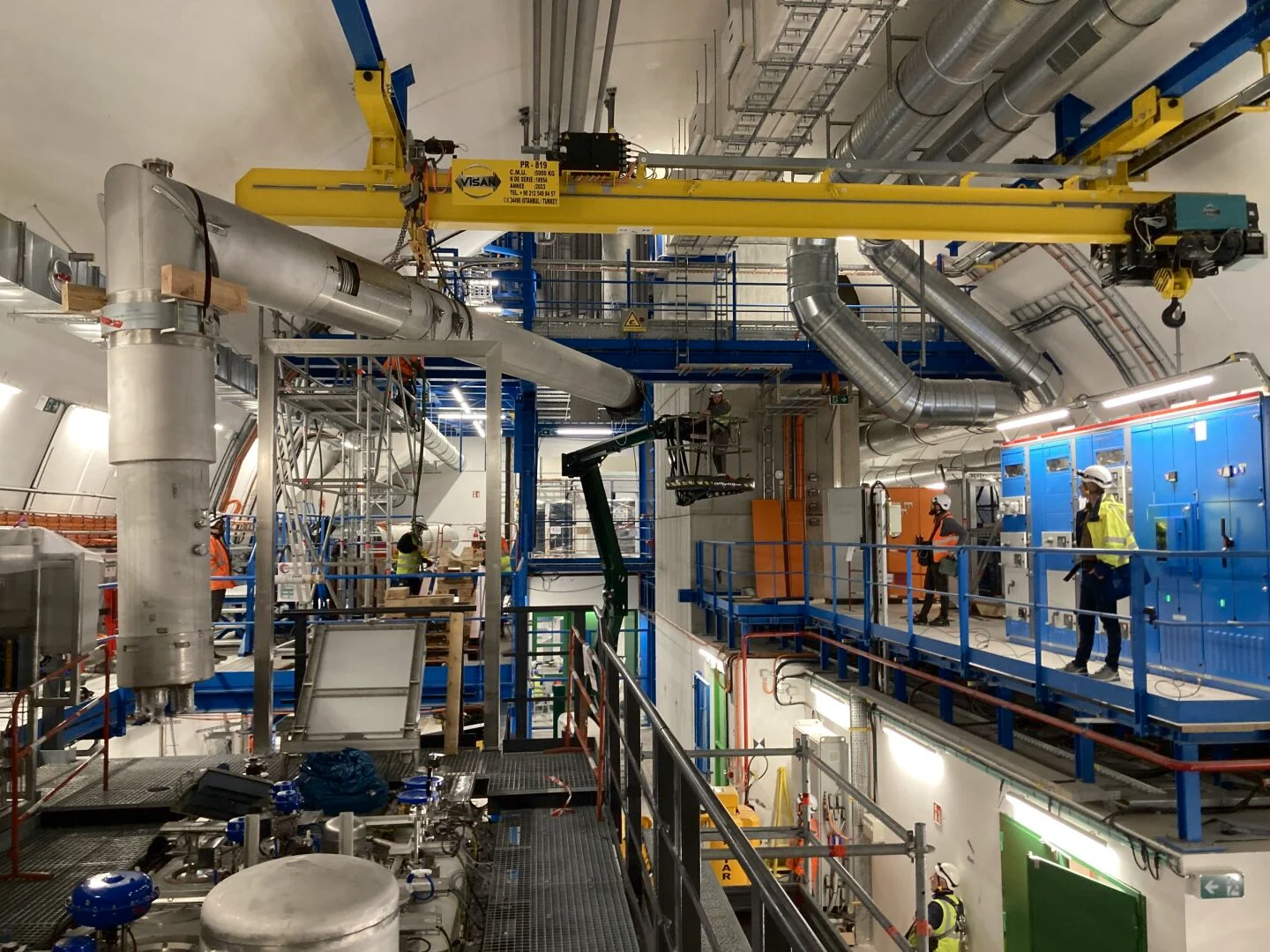
Photo Source: CERN press release on Long Shutdown 3.
There is a barely visible step before installing the equipment. The superconducting magnets of the LHC work at approximately −271 °C. To enable interventions, the teams they remove liquid helium, store it for reuse and gradually heat more than 36 thousand tons of cryogenic equipment. After the renovation, it will be necessary to cool down and test everything again. It is not an overnight change of parts.
What does "ten times more collisions" mean?
In particle physics, Luminosity expresses the ability to produce encounters between particles. It is useful to separate three ideas that appear together in the news:
| Measure | Who answers | What changes in HiLumi |
|---|---|---|
| Collision energy | How much energy is available in a particle encounter? | It is not the target of the "ten times more" ad. |
| Instant brightness | How often do collisions occur during operation? | It should increase with more intense and concentrated beams. |
| Integrated luminosity | How many observing opportunities accumulate over time? | The goal is to reach about ten times the amount foreseen in the original LHC project. |
O CERN itself sets the tenfold target for integrated luminositycompared to Unique design of the machine. This does not mean ten times more energy per collision, nor ten times more data compared to Run 3, which has already exceeded initial expectations.
Imagine looking for a rare instant in a sequence of photographs: increasing the number of photos improves the chance of recording it and allows you to better measure what appeared, without ensuring that the scene you are looking for exists. At the LHC, more collisions give physicists more opportunities to study infrequent processes and to check known measurements. At the meeting of two Packages of protons, HiLumi should produce about 140 to 200 collisions at ATLAS and CMS points, versus approximately 60 in the previous phase, according to the Project technical page.
The official video below shows how proton packets, new magnets, and radio frequency cavities contribute to this increase. It was published by CERN in 2025 and is in English; the visual explanation complements the numbers above, while the updated dates are those of this article.
Why do new magnets help find rare events?
Protons do not travel one by one aiming at an isolated target. They form packets that circulate in opposite directions. The better focused they are when they cross each other inside a detector, the more likely their protons are to meet. The new superconducting quadrupole magnets function as lenses for these beams. Other components, such as the so-called Cavities-crabe, adjust the orientation of the packets to increase their overlap.
In July 8, 2026, an integrated CERN test bench, called IT String, brought the new quadrupoles to their rated current of 16,230 amps. O result, released on July 21, validates an engineering step. It does not mean that the refurbished LHC is already operating: The components still need to be installed and tested on the throttle.
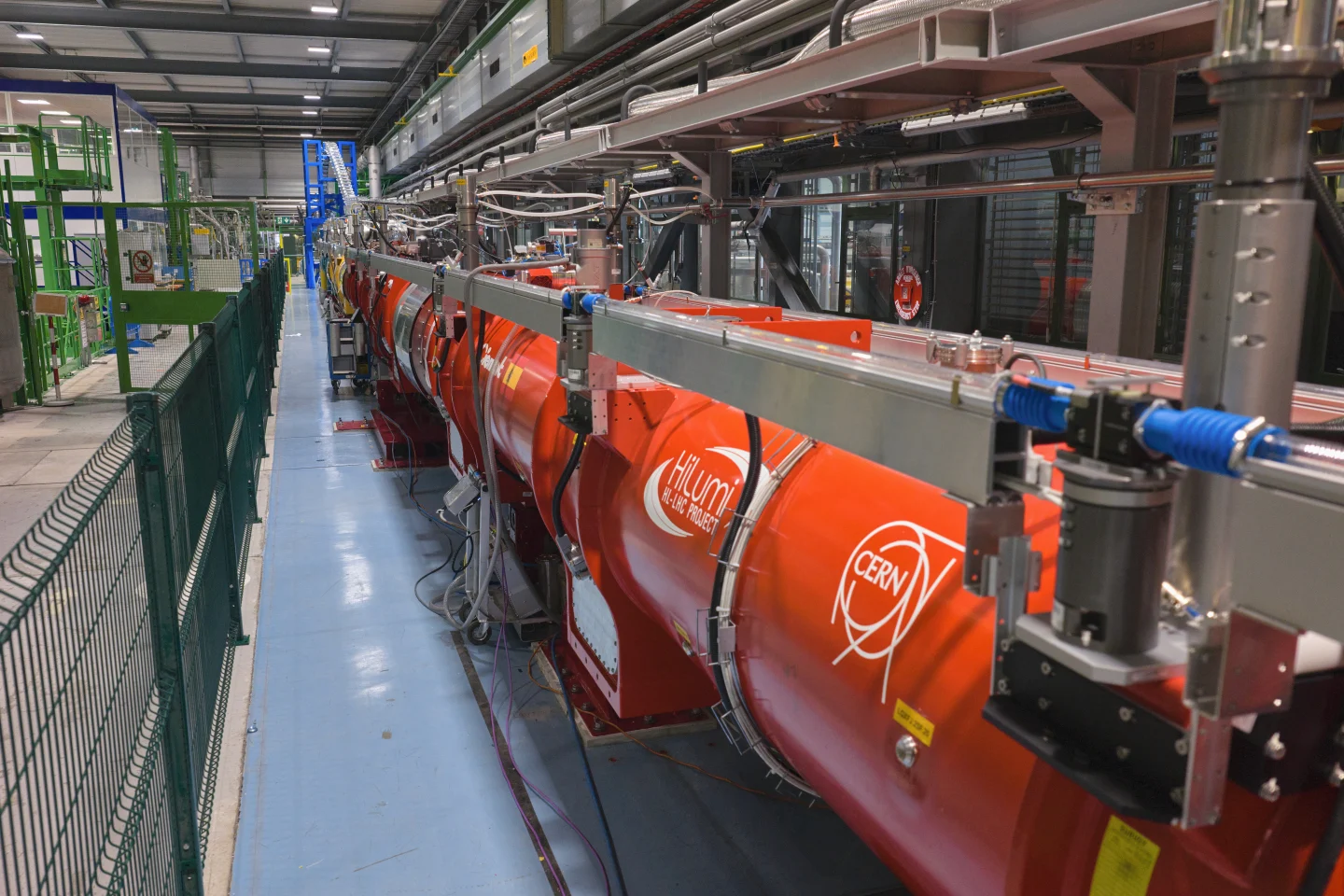
Photo Source: CERN, testing of the new quadrupole magnets.
More collisions also create another problem: separating interesting signals from a huge volume of events. That's why ATLAS and CMS will upgrade their sorting systems and sensors. Detectors can't just receive more particles; they need to identify which interactions deserve to be recorded for analysis. CERN predicts hundreds of simultaneous encounters at each packet crossing, which requires faster electronics and computing.
What can old data still reveal?
Run 3 ended with a considerable collection. According to the CERN Operation Report, this phase delivered more than double the built-in luminosity of Run 2; considering the three phases of the LHC, ATLAS and CMS each came up with about 540 fb⁻¹, above the 300 fb⁻¹ foreseen in the original design. "fb⁻¹", or inverse femtobarn, is the unit used to record the amount of accumulated collision opportunities, not a measure of speed.
These data continue to be examined during LS3. The discovery of the Higgs boson in 2012 opened up questions about its properties and interactions; HiLumi should allow for more precise measurements and more sensitive searches for signals that do not fit the Standard Model. This includes testing hypotheses linked to topics such as dark matter and the difference between matter and antimatter. More data increases the ability to test ideas; it doesn't guarantee a new particle or the solution to those problems.
And the accelerator that can come later?
O Future Circular Collider (FCC) It is another project, separate from the current reform. A European Strategy for Particle Physics recommends studying the FCC-ee, a possible ring of about 91 kilometers for collisions between electrons and positrons. These particles would allow the Higgs to be studied with a precision different from that obtained in the proton collisions of the LHC. The CERN Council hopes to be able to decide on the project in 2028, after analyzing scientific, technical, financial feasibility and public consultations. The construction was not approved.
In August 2026, researchers at the Paul Scherrer Institute tested a possible source of positrons for the FCC. They were able to produce, capture and transport these particles in an experimental system. It is a research step towards equipment that could operate in the future, not the start of a new collider.
For now, the concrete path is the renovation of the existing LHC. If the 2030 schedule is met, the result will be a machine that is more capable of repeat measurements, observe rare processes, and confront theories with data. While it is stopped, the physics continue in the detector files and in the engineering tests that will make the next round possible.
Sources consulted
- CERN: Long Shutdown 3 announcement
- CERN: chronology of the last collisions and beams
- CERN: heating of the LHC during LS3
- CERN: purpose and functioning of the HiLumi LHC
- CERN: test results of the new quadrupoles
- CERN: cumulative performance of the experiments in Run 3
- CERN: strategy for the possible FCC-ee
- CERN: positron source testing for the FCC
- CERN: video about beams for the HiLumi LHC