Science and innovation
Dyson Spheres: From 1937 Fiction to the Candidates Investigated by James Webb
The idea started in fiction, became a scientific search for infrared heat and reached James Webb. Understand how a Dyson swarm would work and what happened to the 2024 candidates.
By Ederson Andrade · September 10, 2026 · 14 min read
Audio
Listen to this article
18 minutes, approximately
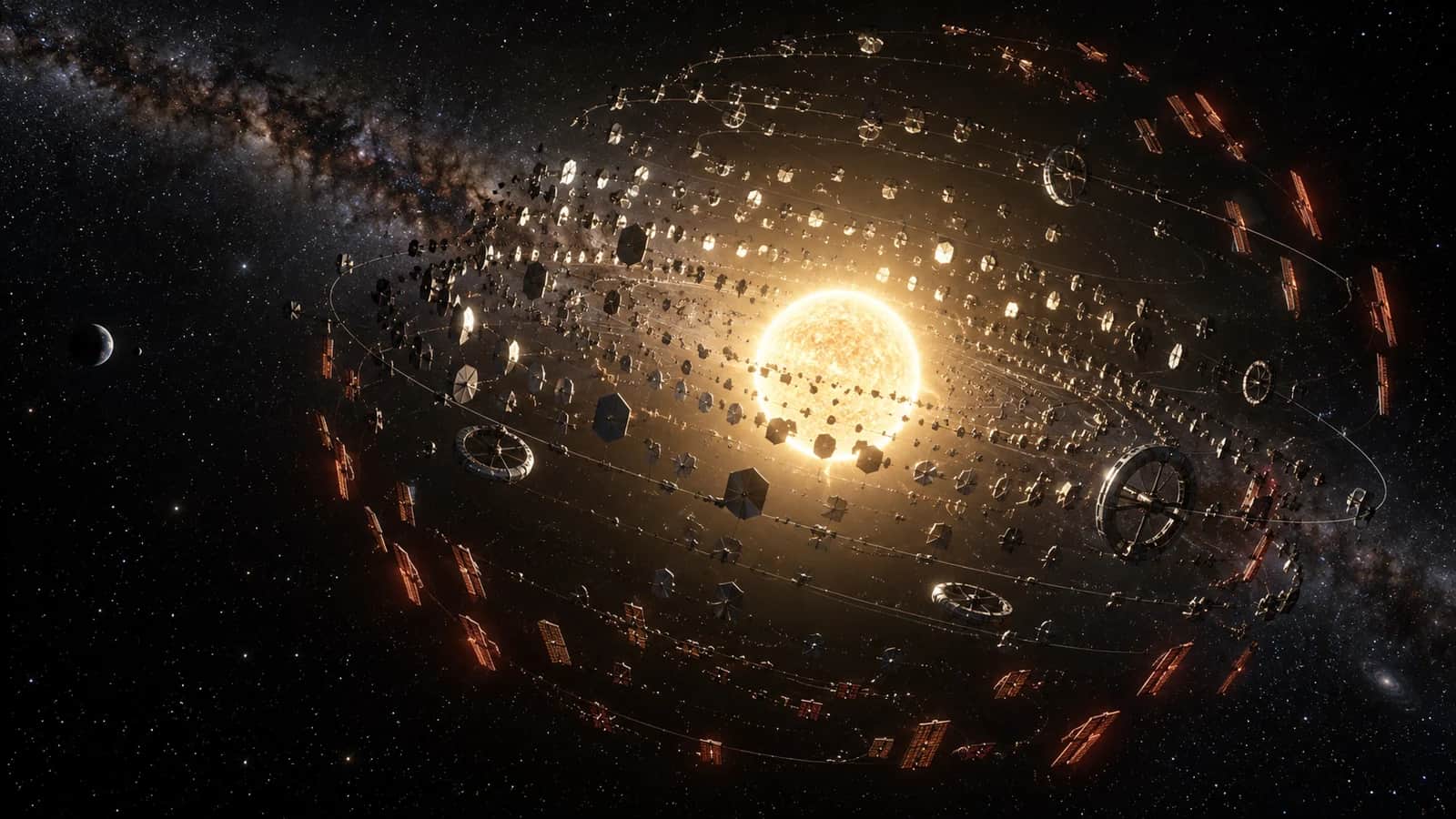
The best-known image of a Dyson sphere looks like something out of science fiction: a gigantic shell enveloping an entire star. The proposal that has made it to astronomy, however, is different. It describes a system made up of countless collectors, habitats, and other independent structures, all orbiting the star to harness an ever-increasing portion of its energy.
This distinction matters because the solid sphere popularized by illustrations and movies faces enormous physical problems. Already a Dyson Swarm It does not violate any known laws of nature. Building it would be far beyond current human capacity, but looking for its possible signs is a legitimate scientific question.
Since the 1960s, astronomers have turned this question into a search for infrared heat, unusual dimmings, and other signals that a technological civilization could leave in the sky. The result, even September 8, 2026, is both fascinating and sober: no object has been confirmed as a Dyson sphere.
The most interesting candidates taught something important. An anomaly is the beginning of investigation, not the discovery of aliens.
Before Dyson, the idea was born in fiction
In 1937, the British writer and philosopher Olaf Stapledon published the novel Star Maker. The book imagined very ancient civilizations using the light of their stars on a gigantic scale. Decades later, Freeman Dyson recognized that the work had influenced his thinking, as recorded in the University of Liverpool.
Stapledon did not present an engineering project. His role was to imagine a civilization whose relationship with energy and space no longer fit within the boundaries of a planet. This idea set the conceptual stage for the question Dyson would ask as a physicist.
1960: Freeman Dyson turns fiction into an observable quest
On June 3, 1960, the magazine Science published the article by Freeman Dyson Search for Artificial Stellar Sources of Infrared Radiation. The text is only two pages long, but it proposed a profound change in the search for extraterrestrial intelligence.
Instead of waiting for an intentional radio message, we could look for unintended consequences from a very advanced civilization. If it captured a large fraction of its star's light, it would use that energy, and at the end of the process, it would need to release heat into space.
Dyson suggested that this system would appear as an unusual source of far-infrared radiation. The star would be partially or almost entirely hidden in visible light, while the energy would reappear at wavelengths associated with heat.
The central point was never to draw a perfect metallic ball. In his article, Dyson spoke of a loose collection, or swarm, of objects. The name "Dyson sphere" ended up becoming more famous than the architecture actually imagined.
Sphere, swarm, bubble or ring: what each name means
Astronomer Jason Wright reviewed the history and physics of these structures in the paper Dyson Spheres, accepted by the Serbian Astronomical Journal. The revision helps to separate concepts that appear mixed in popular culture.
| Concept | What would it be like | Main difficulty |
|---|---|---|
| Dyson Swarm | Thousands or millions of collectors and habitats in independent orbits | Requires colossal amount of material, orbital coordination, and maintenance |
| Solid shell | A continuous surface surrounding the star | It would not remain passively centered and would suffer extreme structural stresses |
| Dyson Bubble | Very light collectors balanced between gravity and light pressure | Relies on extremely sophisticated materials and control |
| Ring | Structures concentrated in an orbital range | Captures only part of the light and also needs stability and control |
O Swarm it is the closest model to Dyson's proposal. Each element would follow its own orbit, like satellites around the Earth, but in incomparably greater numbers.
A civilization wouldn't need to build everything at once. It could start with a few collectors, scale up the mining of asteroids and planets, and add new structures over thousands or millions of years. Seen from afar, a partial construction would still make the star visible, but it would alter its luminosity and add thermal emission.
Why a solid shell doesn't work as it seems
A rigid surface the size of a planetary orbit would require materials capable of withstanding forces far beyond what we know. There is also a stability problem: if the star were to move slightly relative to the center of the shell, gravity would not automatically produce the restorative force needed to put it back at the center.
This does not mean that every megastructure is impossible. It just means that the most famous design is the least convincing. A swarm uses orbital dynamics already observed in nature. Its difficulty lies in the scale of the required industry, not in new physics.
The cover illustration of this article represents this more plausible version: separate objects, gaps It is an editorial preview, not a photograph of a discovery.
1964: The Kardashev scale puts the idea in context
Four years after Dyson's paper, Soviet astronomer Nikolai Kardashev published a ranking of civilizations based on the amount of energy they can utilize. O original article from 1964 described three general levels.
- Type I: energy available on a planetary scale.
- Type II: Star-scale energy.
- Type III: energy on a galactic scale.
Dyson and Kardashev did not create the same theory together, but the two ideas complement each other: one classifies the energy scale and the other suggests a possible observable signal.
The fundamental clue is wasted heat
No real machine transforms energy with perfect efficiency. Computers, factories, lighting, and even living organisms end up releasing some of that energy as heat. A civilization that utilized much of a star's power would also need to reject that heat into space.
That's why researchers look for a strange combination:
- less visible light than expected for that star;
- excess infrared radiation;
- a distribution of energy compatible with heated structures;
- absence of a simpler natural explanation.
The search for this type of signal is called the search for Tecnossinaturas. A NASA describes technosignatures as measurable indications of distant technology, including light patterns and heat emissions.
But infrared does not belong to civilizations. Heated dust, disks around young stars, very distant galaxies, active galactic nuclei and alignment errors between catalogs can produce similar signals.
How telescopes learned to search
1980s and 1990s: the infrared sky enters the map
Launched in 1983, the IRAS satellite surveyed almost the entire sky in infrared. For the first time, astronomers had a catalog wide enough to look for sources that resembled Dyson's prediction.
In 2009, Richard Carrigan published a systematic analysis of IRAS data in the Astrophysical Journal. The study examined approximately 250 thousand sources, applied filters and inspected spectra. Few ambiguous objects remained, but no convincing case of extraterrestrial technology.
The work showed how the research matured. It was not enough to find something hot. It was necessary to eliminate stars shrouded in dust, nebulae, galaxies and problematic measurements.
2010 to 2015: WISE expands the scale of the search
The WISE space telescope mapped the sky in infrared bands with better sensitivity and resolution than those available to IRAS. That data fed into the G-HAT project, led by Jason Wright, which searched for wasted heat not only in stars but also in entire galaxies.
In 2015, a Study with about 100 thousand galaxies It did not find any clearly dominated by artificial heat. Some unusual sources were separated for follow-up, but the research has mostly established limits: Civilizations that reuse much of the light from nearby galaxies do not appear to be common in the data analyzed.
Tabby's star and the strength of a good natural hypothesis
In 2015, KIC 8462852, known as Tabby's star, became famous for showing irregular dips in brightness that reached approximately 20%. The pattern was difficult to explain, and the possibility of large orbital structures received enormous public attention.
Later observations compared the dimming in different colors. A NASA/JPL reported in 2018 that blue light was blocked more intensely than red. Opaque and large objects would block colors in a more similar way. Very small grains of dust, on the other hand, produce just this difference.
Tabby did not become a confirmed Dyson sphere. It became an excellent example of the scientific method: an extraordinary hypothesis was tested by an observable prediction and lost strength in the face of a natural explanation.
2022: the Hephaistos Project is born
The Hephaistos Project took the search to modern catalogs. Its first stage combined data from the Gaia observatory with measurements from WISE and analyzed more than 100 million objects. The goal was to calculate limits to the frequency of partial spheres, not to announce a detection.
O first study, published in 2022, showed that large public surveys can test specific models of megastructures. Depending on the distance, temperature, and fraction of the star covered, the researchers obtained thresholds as low as approximately one object in 100,000 in the most restrictive scenarios. Even these objects could be natural false positives.
2024: seven candidates draw attention
In May 2024, the second stage of the project analyzed about five million fonts observed by Gaia, 2MASS, and WISE. A sequence of filters searched for nearby stars with excess infrared, rejected hazy regions, low-quality data, and visually contaminated images.
O Hephaistos II Project article it ended up with seven candidates, all classified as small M dwarf stars at less than 300 parsecs. The signals were compatible with models of partial spheres that would cover between 10% and 90% of the star's light and have temperatures between 100 and 700 kelvin.
"Compatible" is the decisive word. The authors themselves stated that it is essentially impossible to prove the existence of a Dyson sphere with photometry alone. The seven sources were a priority list for new observations, not seven discoveries.
One difficulty was in the resolution of WISE. In some bands, the telescope combines objects separated by a few arcseconds at the same point. A nearby star may appear to be associated with an infrared source, which is actually a distant galaxy in almost the same line of sight.
2025: Candidate G finds a background explanation
High-resolution radio telescopes investigated the so-called G candidate. published in 2025 in Monthly Notices of the Royal Astronomical Society: Letters, found a compact radio source close to, but not coincident with, the M dwarf.
The characteristics were compatible with an active galactic nucleus in the background. In other words, a supermassive black hole feeding at the center of a distant galaxy could explain the excess infrared initially attributed to the star. Candidate G is no longer a strong case of a megastructure.
2026: James Webb separates star and galaxy
In July 2026, a team published the preprint of the Hephaistos IV Project, still subject to the scientific review process. The study used the James Webb telescope's MIRI instrument to observe candidates D and E with much higher resolution and spectroscopy.
The result was straightforward: in both cases, the infrared excess did not come from a structure around the star.
- Behind candidate D, Webb found a galaxy at about 0.9 redshift, with characteristics of a very hot, dust-obscured galaxy.
- Behind candidate E, there was a dusty galaxy with intense star formation at a redshift of about 0.4.
The galaxies were projected about one arcsecond from the stars. WISE couldn't separate them clearly, but Webb could.
Another preprint from July, the Hephaistos III Project, gathered observations and stellar parameters from the original candidates and other similar sources. Some anomalies still require investigation, but no evidence has emerged that warrants the technological explanation.
The correct state of history in September 2026 is this: two candidates have been resolved as background galaxies by Webb, one has been associated with an extragalactic radio source, and the others are still under analysis or have marginal signals. None is a confirmed Dyson sphere.
In the video, astronomer Jason Wright explains the observational logic used to search for megastructures. The content is in English and is displayed within TecEdi.
Dyson Sphere Timeline
| Year | What happened | Why it matters |
|---|---|---|
| 1937 | Olaf Stapledon publishes Star Maker | Fiction imagines civilizations using stellar energy on a large scale |
| 1960 | Freeman Dyson proposes to look for artificial sources in infrared | The idea becomes a testable astronomical hypothesis |
| 1964 | Nikolai Kardashev presents his energetic scale | Dyson structures come to represent a Type II civilization |
| 1983 | The IRAS satellite maps almost the entire infrared sky | Large catalogs allow for the first systematic searches |
| 2009 | Carrigan publishes a search on IRAS data | Few ambiguous candidates survive, none are confirmed |
| 2015 | WISE and G-HAT expand search to nearly 100,000 galaxies | The result imposes limits on the presence of extreme artificial heat |
| 2015 to 2018 | Tabby's star is investigated | Data in various colors favor dust, not opaque megastructures |
| 2022 | Hephaistos I project analyzes more than 100 million objects | Modern search begins to combine Gaia and WISE on a huge scale |
| 2024 | Hephaistos II presents seven M dwarf candidates | The sources justify monitoring, but do not prove technology |
| 2025 | High-resolution radio investigates candidate G | An active galaxy in the background explains the most likely signal |
| 2026 | James Webb looks at candidates D and E | Both emissions come from background galaxies, not stars |
Why false positives don't make search useless
It may seem disappointing to find that a candidate was dust or a distant galaxy. In practice, this is how astronomy progresses. Each rejection improves filters, reveals instrument limitations, and helps decide which objects deserve the scarce time of more powerful telescopes.
WISE observes a wide swath of the sky and finds possible excesses. Gaia provides distances and characteristics of stars. Radio telescopes locate compact emissions. James Webb separates very close objects in the field of view and analyzes their spectra. No single instrument delivers the answer.
The same investigation also finds interesting astrophysics: young stars, dusty disks, obscured galaxies, and active galactic nuclei. A search for distant technology can yield knowledge even when the ultimate explanation is natural.
What it would take for a compelling discovery
A serious ad would need to survive several independent steps:
- The excess infrared would have to follow the star's position and motion exactly.
- Dust, circumstellar disks, background galaxies, and instrumental errors would need to be ruled out.
- The spectrum would have to be compatible with repurposed heat and difficult to reproduce by natural processes.
- Radio, optical, and infrared observations should tell the same story.
- Other groups would need to repeat the analysis and confirm the signal.
Even an odd signature wouldn't automatically suffice. The "extraterrestrial technology" conclusion would only gain traction after well-tested natural explanations failed.
The hypothesis also has limits
Every search for Dyson spheres depends on assumptions. Perhaps a civilization uses only a small part of the star's light. Perhaps it keeps radiators that are too cold, difficult to detect. Perhaps it directs some of the energy to narrow signals, movement of matter, or other purposes. We also don't know if civilizations last long enough to build something that big.
Therefore, not finding hot and bright spheres does not demonstrate that we are alone. The result only reduces the space for certain types of technology within the observed region and sensitivity.
The strength of Dyson's proposal lies precisely there. It does not try to guess what aliens look like. It starts from general physical principles, it turns an idea into a prediction and allows data to eliminate possibilities.
From imagination to telescope
The story of the Dyson sphere has come a rare way. It was born in a novel, became a physical hypothesis, entered astronomical catalogs and reached the agenda of the James Webb telescope.
So far, the search has found natural phenomena, background contaminations, and questions that are still open. This does not diminish the importance of the work. It shows that science can investigate one of the most daring ideas about life in the Universe without exchanging evidence for desire.
If one day such a structure is found, it will not be recognized by a single spectacular image. The breakthrough will come from the patient repetition of measurements, the comparison between telescopes, and the ability to reject all the most common explanations.
Meanwhile, technologies that seem like fiction continue to be studied on much smaller scales. At TecEdi, you can also understand how Meta Quest calculates movements using cameras, infrared light, and computer vision and get to know the Samsung smart lens patent.
Sources consulted
- University of Liverpool: the influence of Star Maker about Freeman Dyson
- Original article by Freeman Dyson, Science, 1960
- Jason Wright's Historical and Physical Review of Dyson Spheres
- Original Kardashev scale item, 1964
- NASA: search for technosignatures
- Richard Carrigan's search in IRAS data
- G-HAT project with WISE data
- NASA/JPL: Tabby's Star Dimming and the Dust Hypothesis
- Hephaistos I Project, 2022
- Hephaistos II Project and the Seven Candidates, 2024
- Candidate G's Radio Remarks, 2025
- Hephaistos IV Project: observations of two candidates by the James Webb, 2026 preprint
- Hephaistos III Project: characterization of the candidates, 2026 preprint