Science and innovation
CL1 puts human neurons on a chip, but it's not your average PC
CL1 combines cultured neurons, silicon, life support, and a Python API. Understand how the biological computer works, what it can be used for, and what boundaries and ethical issues still surround it.
By Ederson Andrade · August 29, 2026 · 10 min read
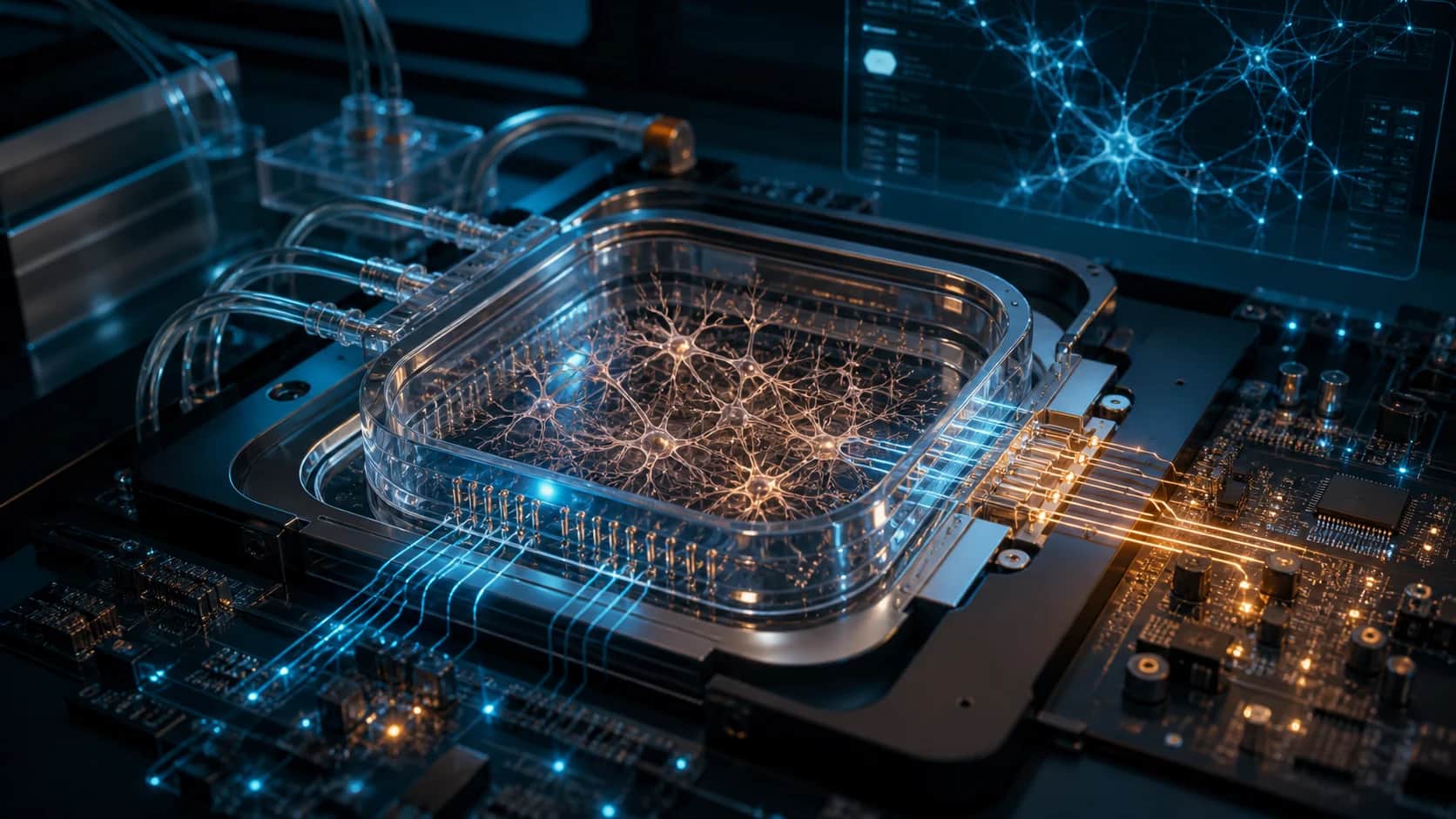
CL1 looks like something out of a science fiction story: human neurons grown in the lab grow on a chip, receive electrical signals from software, and return impulses that can alter a digital environment. Cortical Labs presents the equipment as the first commercial biological computer in which it is possible to deploy code.
The description is eye-catching, but it needs translation. CL1 is not a miniature brain, it does not run Python inside cells, and it does not replace a notebook or a GPU. It is a hybrid research platform that brings together living neural tissue, an array of microelectrodes, conventional electronics, software, and a life support system.
The immediate goal is not to open spreadsheets or train a chatbot. It is to allow researchers to study, in real time, how networks of neurons respond to stimuli, change their behavior, and are affected by diseases or medications. In 2026, the company also started offering remote access through Cortical Cloud, reducing the need to maintain equipment and cell culture in each lab.
What's inside CL1
At the center of the system is a culture of neurons on an array of microelectrodes. These electrodes form a two-way bridge: they send electrical pulses to the biological network and record the calls Spikes, discharges used by neurons to communicate.
The cells are in a nutrient-rich solution. A perfusion circuit controls conditions necessary for the survival of the culture, including circulation of the medium, temperature, gases, and waste removal. According to Cortical Labs, this support can keep neurons viable for up to six months.
Around the biological part, there is still a lot of traditional computing. Processors, firmware and software organize the stimuli, record the electrical activity and execute the environment with which the culture interacts. The equipment also stores applications and recordings and offers a screen to monitor the state of the system.
Therefore, "biological computer" does not mean exchanging all the silicon for cells. CL1 is a system Bio-silicon: each part performs a different function, and the result depends on the closed loop between them.
How software talks to neurons
Cortical Labs calls the system that creates the simulated world presented to neural culture biOS. Information from this environment is converted into electrical stimulation patterns. The response of the neurons is read by the electrodes, interpreted by the software, and used to update the simulation. The new state produces other stimuli, closing the loop.
Imagine a simple agent that needs to move an object to the left or right. The program can represent the position by pulses applied to different groups of electrodes. It then associates patterns of neural activity with an action. When the result changes, the system returns a new sequence of signals. Repeated many times, this interaction allows you to observe whether the network changes its response to the experience.
The programmable part is exposed by the CL API, a Python library. The documentation allows you to start and stop recordings, detect Spikes, stimulate channels, and run closed-loop algorithms. Data can be recorded in HDF5 files for further analysis.
The retry mechanism can operate at up to 25,000 iterations per second, according to the API guide, while a white paper published on arXiv describes closed-loop interactions with latency of less than a millisecond. That speed matters because the software's response needs to keep up with the timescale of neural activity.
A minimal example of the interface looks like this:
import cl

with cl.open() as neurons:
    for instante in neurons.loop(ticks_per_second=1_000, stop_after_seconds=5):
        for spike in instante.analysis.spikes:
            print(spike.channel, spike.timestamp)
The code does not transform each neuron into a predictable instruction. It opens a connection with the equipment and reacts to the detected activity. The biological network continues to be noisy, variable and self-organizing, quite different from a digital processor that must repeat exactly the same operation.
Those who do not yet have access to the hardware can use the SDK simulator. The proposal is to develop the experiment locally and take the same code to a physical CL1 with few changes. The simulator helps to prepare the logic, but it does not reproduce all the variability of a living culture.
From Pong to Doom
CL1 was born from the work that Cortical Labs presented in 2022 with the DishBrain. In that experiment, cultures of human and rodent neurons were connected to a simplified version of Pong. Electrical signals represented the position of the ball, while network activity controlled the racket.
The study published in the journal Neuron reported that the cultures changed their behavior during interaction. The demonstration did not show that the cells understood a video game as a person does. It showed measurable adaptation within a built environment to produce and receive electrical signals.
In 2026, the company returned to the most well-known feature in the history of computing and released a demonstration of Doom run with a CL1 built on top of the Cortical Cloud.
Pong and Doom work well as demos because they make visible an abstract cycle between stimulus, response, and consequence. They are not, however, sufficient benchmarks to compare the CL1 with CPUs, GPUs, or artificial intelligence models. Performance depends on how the game is converted into pulses, what actions are extracted from the culture, and how much conventional software participates in the process.
What CL1 Can Be Useful For
The most concrete application is in biomedical research. Cultures derived from induced pluripotent stem cells can preserve genetic characteristics of a donor. This opens the way for comparing networks produced from different people or creating models associated with neurological diseases.
Instead of looking only at whether a substance kills cells or alters spontaneous firing, researchers can measure how it affects a function during a task: speed of adaptation, stability of response, retention of a pattern, or recovery after a disturbance.
Possibilities include:
- testing compounds in models of epilepsy and other neurological conditions;
- investigate how biological neural networks form and reorganize connections,
- compare responses of cultures with distinct genetic characteristics,
- develop bio-hybrid interfaces for sensors, robotics, and adaptive control;
- to study which mechanisms make biological systems efficient with few examples.
Cortical Labs also presents the equipment as an alternative to animal testing. The platform can reduce the use of animals in some steps and produce data directly in human cells, but this does not make it automatic to replace all models. Each trial still needs to demonstrate reproducibility, clinical relevance and the ability to predict what happens in a complete organism.
From the lab machine to the Cortical Cloud
The CL1 was announced in March 2025. At the time, the IEEE Spectrum reported a price of US$ 35 thousand per unit and weekly remote access as an alternative for teams without cell culture infrastructure. The current value does not appear publicly on the purchase page consulted, so the launch price should not be treated as a current quotation.
Keeping neurons alive requires more than plugging the device into the socket. A physical buyer needs trained personnel, biosafety procedures, inputs, quality control, and proper ethical approval to work with cell lines. The company itself told IEEE Spectrum that the equipment was not made for domestic use.
Cortical Cloud transfers this operation to Cortical Labs' infrastructure. The user accesses Jupyter notebooks in the browser and sends code through a Python library to remote CL1s. The official page states that the platform is available in 2026 and allows you to run experiments without buying or maintaining a device.
In March 2026, the Bloomberg reported the presentation of a small biological computer facility in Melbourne and the construction of another in Singapore. Calling these arrays "data centers" shows the ambition to scale the service, but it does not mean that they already offer the capacity or versatility of a conventional data center.
And the promise of low consumption?
Neurons operate with much smaller electrical signals than those used by high-performance chips. Cortical Labs says its networks learn from less data and use a fraction of the power required by traditional technologies. The equipment also packs life support, recording and applications into a compact unit.
The potential upside is relevant, but comparisons need to use the same task, the same level of accuracy, and all system costs. Pumps, temperature control, culture manufacturing, inputs, and cell replacement are also part of the bill.
In the pages and studies consulted for this article, there is no standardized public benchmark that shows a CL1 outperforming conventional hardware in consumption for an equivalent overall workload. For now, efficiency should be understood as a promising hypothesis and a topic of research, not as proof that biological computers are poised to solve the energy demand of AI.
A neural culture is not a person
The vocabulary surrounding the technology can create a wrong picture. CL1 does not contain a complete human brain. It is a neural culture with no body, sensory organs, brain anatomy, or the organization of billions of cells found in the human nervous system. It is also important not to automatically confuse this two-dimensional culture with a three-dimensional brain organoid.
This does not end the ethical discussion. It includes the consent of those who donated the original cells, the commercial use of human strains, the supervision of experiments, and the possibility of future systems becoming much more complex.
The DishBrain paper used the term "sentience" in an operational sense linked to the ability to respond to sensory impressions. The choice was disputed by other neuroscientists, who considered the evidence of intelligence or emergent sentience to be insufficient. An analysis published in Science and Engineering Ethics He concluded that the experiment offers no clear proof of artificial suffering, but advocated caution as these systems evolve.
The most responsible position today falls between two exaggerations: there is no evidence that the CL1 culture has a consciousness or a subjective experience comparable to that of humans; at the same time, incorporating living neural tissue into interactive systems justifies continuous ethical monitoring, transparent criteria, and limits that can change with the complexity of the technology.
What still limits biological computers
The most immediate challenge is variability. No two crops are born identical, they change over time, and they have a limited shelf life. An experiment needs to separate real learning from noise, deterioration, differences between batches, and effects of the stimulus protocol itself.
There is also an interface bottleneck. Hundreds of thousands of cells can form rich connections, but the software observes and stimulates this activity through a much smaller array of electrodes. Increasing the number of neurons does not automatically increase the useful information that enters and leaves the system.
Other limits are equally important:
- there is still a lack of standardized tasks that allow comparing cultures, algorithms and chips;
- results need to be reproduced by independent laboratories;
- commercial applications beyond research remain experimental;
- maintaining living tissue creates costs and failures that do not exist in conventional hardware;
- Scaling the platform requires reconciling biology, manufacturing, software, and ethical governance.
The CL1 solves an important part of this problem by packaging instruments that previously required specialized mounts. A 2025 article in Nature Reviews Bioengineering, signed by the chief scientist of Cortical Labs, describes the platform as a scalable device for interacting with closed-loop neural cultures with integrated life support. The author's link to the company is stated in the publication itself and should be considered when interpreting the perspectives presented.
Why CL1 matters even without replacing your computer
The breakthrough of CL1 isn't in proving that neurons beat silicon. It's in turning a complex lab assembly into a platform that can be programmed, repeated, and accessed by more researchers.
If this standardization works, it could speed up studies on plasticity, diseases, and drugs, and allow comparisons that are difficult today. It also creates a new area for developers: writing environments and protocols that can exchange information with living networks in real time.
The most interesting result may not be a purely biological computer. It may be a class of hybrid systems in which electronics offer precision and scale, while cells provide adaptation and biological dynamics. CL1 is a commercial attempt to put this combination on a bench and now, behind an API in the cloud.
Sources consulted
- Cortical Labs: CL1 official website
- Cortical Labs: Introducing Cortical Cloud
- Official CL API and simulator documentation
- CL API white paper on arXiv
- Nature Reviews Bioengineering: CL1 as a Platform for Biological Neural Systems
- Nature: Neurons in culture learn to play a version of Pong
- IEEE Spectrum: CL1 Launch, Architecture, and Starting Price
- PubMed/Neuron: Critical response to claims of intelligence and sentience
- Science and Engineering Ethics: DishBrain's Ethical Challenges
- Bloomberg: Biological computer facilities in Melbourne and Singapore
- Cortical Labs on YouTube: Doom demo in a CL1
Calculation completed on August 24, 2026. CL1 and Cortical Cloud are evolving technologies; capabilities, availability, and pricing may change.