Hardware
Samsung's smart lens wins patent: what it does and what's there in 2026
Samsung Display has been granted a patent in South Korea for a contact lens with a microdisplay, antenna, battery and sensors. Understand how the technology would work and why it is not yet a product.
By Ederson Andrade · August 31, 2026 · 10 min read
Audio
Listen to this article
13 minutes, approximately
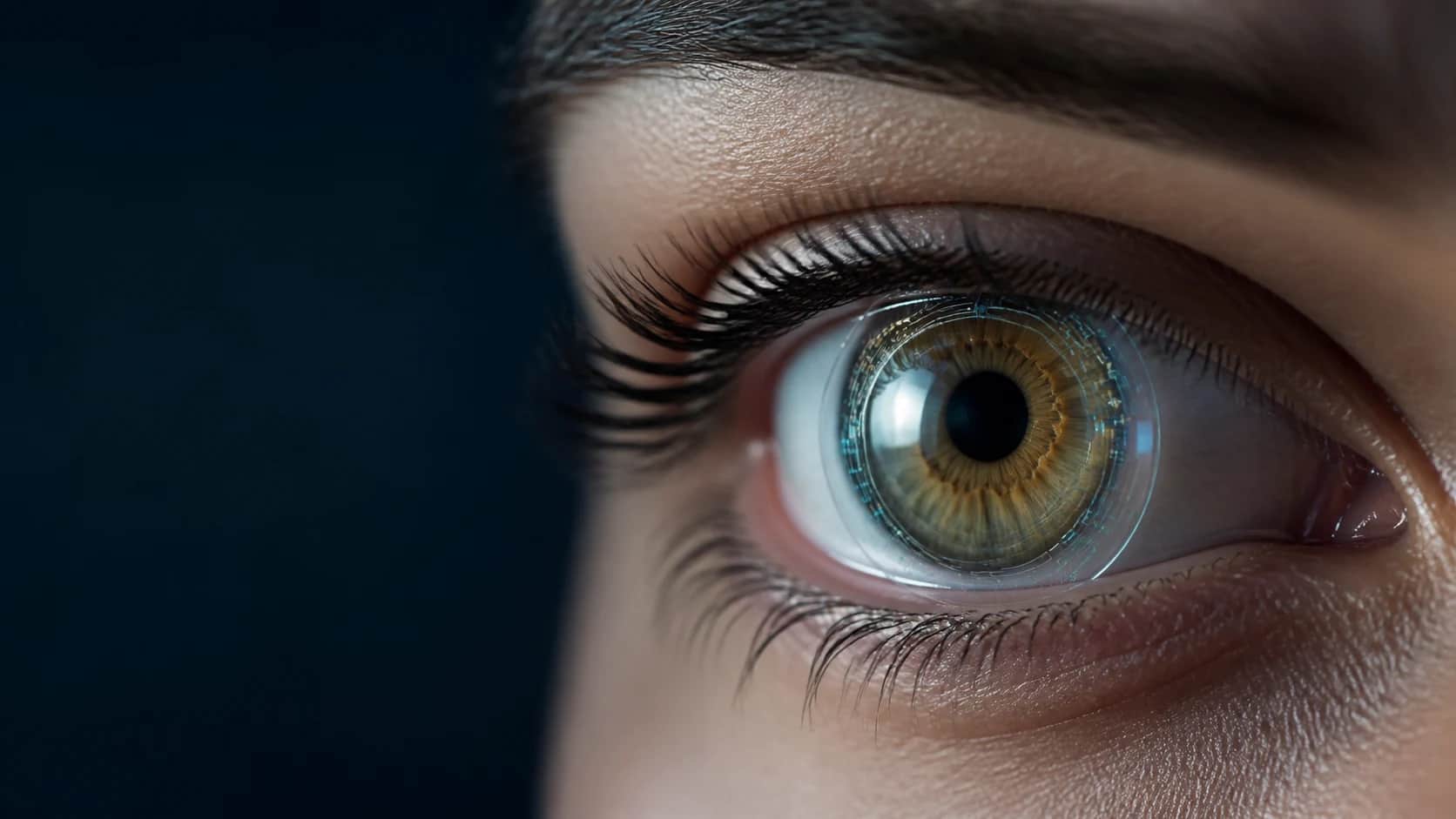
The most discreet screen that Samsung has ever described in a patent is not on the wrist, on the face or in the pocket. It touches directly on the eye. The document features a smart contact lens with a transparent display area, circuitry shifted to the periphery, radio frequency antenna, battery and controller. In some configurations, the set could also receive motion sensors and a camera.
The issue drew attention again in 2026 because the most recent patent family reached an important milestone in South Korea. The intellectual property right was granted on March 17, and the document was registered as KR102942304B1 was published on March 23, 2026. In the United States, the corresponding version, US12411359B2, had already been granted on 9 September 2025.
That doesn't mean a Galaxy Lens is ready to hit stores. Samsung hasn't announced a smart contact lens as a commercial product. Patent, prototype, and product are different stages. What the document allows us to understand is how Samsung Display imagines solving one of the most difficult problems in augmented reality: putting a screen in front of vision without blocking the real world.
What really happened in 2026
The South Korean application was filed on February 22, 2021, and published for consultation in September 2022. After examination, amendments, and payment of fees, the registration was granted and published in March 2026. The holder is the Samsung Display, the group's company specializing in screens, and the inventors listed are Junghun Lee and Jiheon Lee.
The grant gives legal protection to accepted claims. It does not prove that scale manufacturing has been resolved, that clinical trials have been completed, or that the company has decided to sell the device. It also does not reveal price, autonomy, final resolution, or release date.
The same invention has versions in other countries. The North American application was filed in November 2021, became public in August 2022 and became a patent granted in September 2025. In China, the family appears as a published application. This international distribution shows that Samsung considered the architecture valuable enough to protect it in important markets, but has not yet turned the idea into a product.
The story began earlier: from 2014 to the new patent
This isn't Samsung's first attempt at putting electronics in a contact lens.
In September 2014, Samsung Electronics filed an application in South Korea for an augmented reality smart lens. The proposal brought together a display unit, peripheral components, antenna, eye movement sensor and the possibility of a camera. The application appeared publicly in 2016, received a patent in the United States in 2019 and a South Korean grant in 2021.
In that generation, the idea of photographing or controlling functions with the blink of an eye made more headlines than screen engineering. The video below, published by CNET in 2016, records how the first patent was presented to the public at that time.
The family started in 2021 is more specific. Rather than just describing future functions, it focuses claims on the flexible panel structure, the transparency of the central area, and the separation between the elements that emit light and the circuits that control them. It's an important evolution because an augmented reality lens needs to display information while also continuing to function as a window to the world.
Summary timeline
- 2014: Samsung Electronics files the first family patent for an augmented reality lens.
- 2016: The old request becomes public and the idea gains international repercussion.
- 2019: The first architecture receives the North American patent US10317704B2.
- 2021: Samsung Display deposits a new proposal centered on the transparent and flexible panel.
- 2022: the most recent family is published in the United States, South Korea, and China.
- 2025: the United States grants the patent US12411359B2.
- 2026: South Korea grants and publishes the patent KR102942304B1.
How the lens described by Samsung would work
The architecture can be understood as an extremely thin sandwich. A first flexible layer would face the eye. On it would be mounted the display panel, accompanied by an antenna, battery and controller. A second layer would cover and encapsulate the set.
The document divides the surface into regions with different tasks.
The central area needs to let the light through
The first region coincides with the central part of the lens and the user's pupil. It is there that the emitting elements would form the virtual image. The patent admits different emission technologies, including OLED, microLED, gallium nitride nanorods and quantum dots.
The challenge is that a pixel is not transparent like the material of a common lens. Data lines, transistors and capacitors also take up space and block part of the light. The solution described is to keep the elements responsible for the image in the central region and move a large part of the activation circuits to a peripheral region, above the iris.
Connecting wires would carry signals and power between these areas. Some claims describe these conductors in a serpentine shape. The geometry helps the panel follow the curvature and deformation of the lens without concentrating all the mechanical effort in a straight line.
The periphery concentrates electronics
At the edge would be the controller circuit, the RF antenna and the battery. The antenna would serve to exchange information with an external device and could also receive wireless power. The battery would power the display and controller, while the heavier processing could continue on a smartphone or other nearby device.
The patent also mentions sensors capable of perceiving eye movement or blinking and considers a camera working in conjunction with these sensors. These are possibilities described in the document, not a confirmation that all will be present in an eventual product.

Why a screen so close to the eye can't be a miniature cell phone
A panel within a few millimeters of the cornea is not automatically sharp. The human eye cannot focus on a screen simply glued to its surface. A real system needs to direct and collimate light so that the image appears to be at a comfortable distance, without preventing the user from seeing the environment.
This optical problem adds to the resolution. An image that is too small can be used for simple symbols, alerts, and arrows. Detailed text, maps, and convincing objects require more pixels, better color control, enough brightness for outdoors, and low enough power consumption not to heat the eye.
Samsung has been researching very thin optical components on other fronts. In 2025, the company and POSTECH published a study on a compact achromatic metallens for eyepiece cameras and XR devices. The research may contribute to smaller equipment, but it is not part of this contact patent and should not be presented as proof that the lens already works.
To understand how current devices calculate the position of the eyes, head and hands, TecEdi also explains the science of tracking used by Meta Quest. The article on the XREAL Aura and Android XR It shows a step closer to the market: glasses that distribute screen, sensors, battery and processing in a much larger structure than a contact lens.
Samsung's actual product in 2026 is a pair of glasses
While the lens patent advanced in intellectual property offices, Samsung's commercial strategy followed a more conventional path. In July 2026, the company officially presented its line Intelligent Eyewear, developed with Gentle Monster and Warby Parker.
The announced glasses have a camera, microphones, speakers, sensors, Snapdragon AR1 Gen 1 platform and integration with Gemini and Galaxy phones. Samsung reports autonomy of up to nine hours, in addition to additional recharges through the case. The device can record what the user sees, organize information, assist in navigation, translate conversations and share images in calls.
This comparison helps to size the engineering abyss. In a frame there is room to spread battery, processor, antennas and thermal dissipation. In a lens, everything needs to remain thin, flexible, transparent, moist, safe and comfortable on a sensitive biological surface.
In official materials consulted until August 31, 2026, Samsung presents the glasses as its wearable artificial intelligence product. The company has not announced a sale, public prototype, human trial, or commercial timeline for the patented contact lens.
The obstacles that still separate the patent from the eye
Oxygen and comfort
The cornea does not have blood vessels to receive oxygen in the same way that other tissues do. Modern soft lenses use permeable materials to allow oxygen to pass through. Chips, electrodes, tracks, battery, and encapsulation layers make it much more difficult to preserve this characteristic.
A scientific review published in 2026 highlights that oxygen permeability, amount of water, wettability, thickness, curvature, and stiffness need to be reevaluated when electronic components are incorporated. The FDA warns that even conventional lenses can cause infection, abrasion, and corneal ulcer when used incorrectly.
Energy and heat
Transmitting energy by radio frequency reduces the need for a large battery, but requires proximity to a source and high efficiency. An integrated battery increases autonomy, but it takes up area and needs to remain safe even when flexed and surrounded by tears.
All energy that does not become light, signal or useful processing ends up in the form of heat. In a cell phone, this heat spreads through the housing. In a lens, any increase in temperature happens near the eye. The thermal limit is therefore a central part of the design.
Encapsulation and durability
The tear contains water and salts. Electronic circuits cannot be exposed to this environment, and the materials used to insulate them cannot release harmful substances either. The patent describes encapsulation with inorganic and organic layers over the display, but a medical product would require tests for biocompatibility, sterilization, resistance, and aging.
Privacy
An almost invisible camera would raise an even greater social problem than that encountered by camera glasses. People around would need to know when they are being recorded. It would also be necessary to protect images, biometric signals, and eye movement patterns. The existence of the camera as a possibility in the patent does not solve consent, security, or legislation.
Can the lens replace the cell phone?
In the short term, there is no basis for this prediction. The patent itself presupposes communication with an external device, which can provide data, programs, and energy. The most plausible scenario would be that of a complementary interface: the lens would display simple information while another device would connect, store, and process.
Even this version depends on simultaneous advances in transparent displays, optics, wireless power, flexible batteries, encapsulation, permeable materials, data transmission, and regulatory approval. Solving just one of these points is not enough.
The value of the patent lies in showing how Samsung intends to visually and electrically separate the center and periphery of the lens. The transparent part preserves vision, while the more opaque circuitry is pushed off the main axis. It's a coherent and technically detailed idea, but it's still an engineering map, not a finished product.
What we know so far
The correct news of 2026 is that the South Korean patent for the latest architecture has been granted and published. Samsung Display protected a contact lens with a flexible and transparent panel, peripheral circuits, antenna, battery, and controller. The document also provides for sensors and camera in some configurations.
What doesn't yet exist publicly is equally important: there's no trade name, price, launch, final technical sheet, medical approval, or official demonstration of the lens working on a person. The actual device presented by Samsung in 2026 was a smart glasses.
If the technology hits the market, it could turn augmented reality into something almost invisible. Until then, the best way to see this novelty is with curiosity and caution. The patent proves that Samsung is working on the problem. It does not prove that the problem has already been solved.
Sources consulted
- South Korean patent KR102942304B1 and history of the process
- U.S. patent US12411359B2, granted in 2025
- Samsung's first patent family, US10317704B2
- Samsung Intelligent Eyewear Official Announcement July 2026
- Samsung and POSTECH Compact Metallens Research
- 2026 Scientific Review on Sensors in Smart Contact Lenses
- Review on ways to power smart contact lenses
- FDA Guidance on Contact Lens Types and Permeability
- Risks associated with wearing contact lenses, according to the FDA