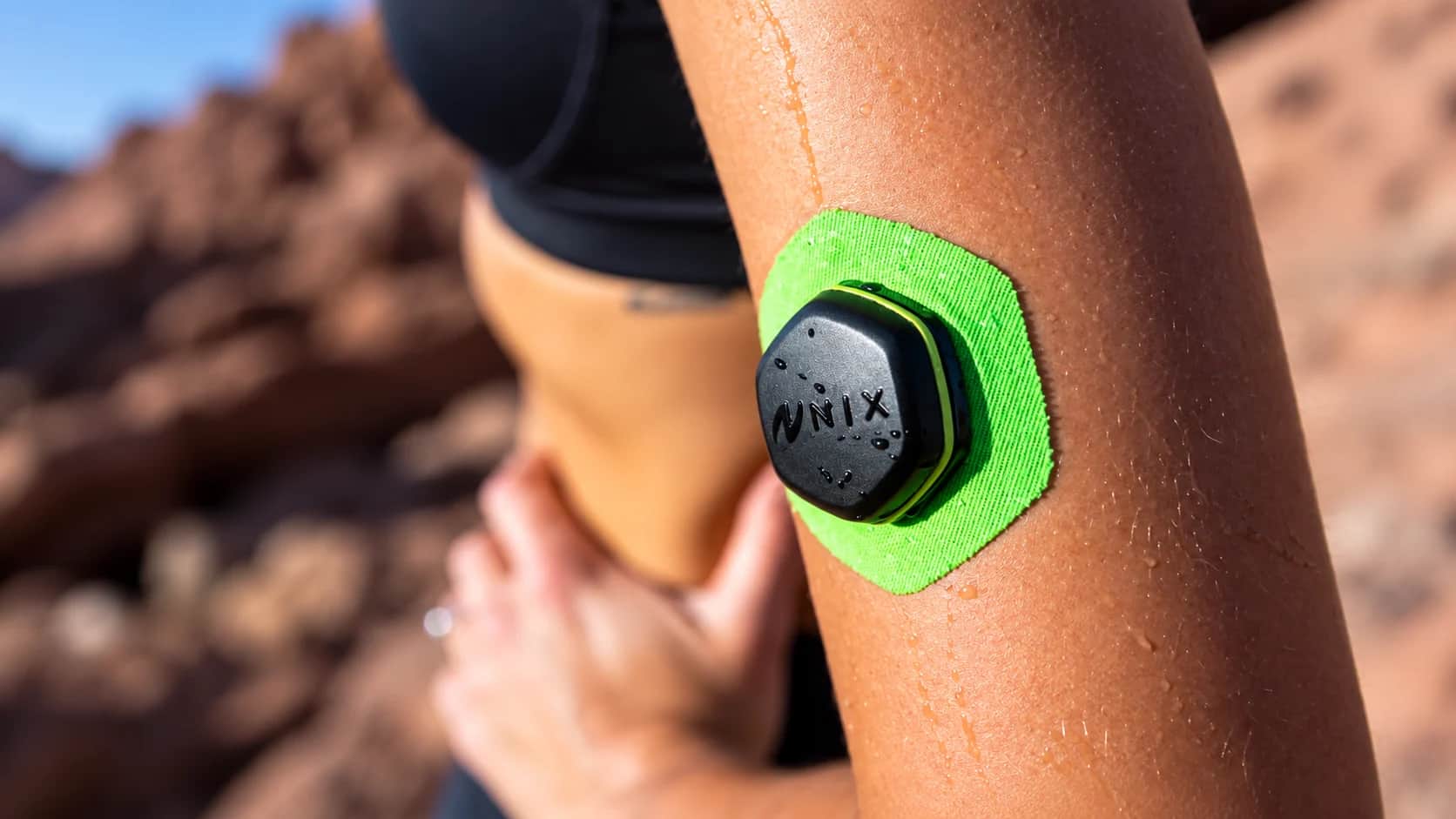
Sweating a lot does not necessarily mean losing the same amount of salts as someone else. Temperature, humidity, intensity, acclimatization and individual characteristics change the volume and composition of sweat. It is in this problem that the North American Nix Biosensors tries to enter with a small sensor attached to the arm.
O Nix Hydration Biosensor It combines two parts. A disposable patch collects sweat on the biceps, while a reusable electronic module, called a Pod, reads signals from the liquid and sends the results via Bluetooth. The app turns those readings into estimates of fluid and electrolyte loss, as well as issuing warnings about when to drink and how much to replace during exercise.
The idea is appealing, especially for those who run, cycle or train for long periods. But the correct explanation requires an important distinction: the device does not look at the blood and does not directly measure the body's hydration status. It measures sweat properties in a region of the skin and uses proprietary algorithms to estimate what happens in the entire body.
What's in the Nix and how much does it cost
The set sold by the company includes a rechargeable pod, four single-use patches, charging case and USB cable. In the consultation carried out by TecEdi on September 7, 2026, the kit cost $189 on the official website. A pack of four extra stickers cost US$ 25, the equivalent of $6.25 per session before freight and taxes.
The Pod weighs less than half an ounce, about 14 grams, and its battery life can last up to 36 hours. The patch is just under 2.75 inches in diameter, approximately 7 centimeters, uses latex-free medical-grade acrylic glue, and should be discarded after each workout. Reusing it can compromise sweat flow and reading.
Nix recommends the product mainly for activities with evident sweat and duration of 45 minutes or more. The sensor withstands sweat and rain, but it cannot be submerged. In a triathlon, for example, the company itself advises that the patch be applied to dry skin only after swimming.
These details show the first practical limit. The electronic component is reusable, but each monitored workout consumes a new patch. For someone who wants to measure five sessions per week, the recurring cost of patches can exceed $30 per week, without importing.
How sweat turns into a number on the screen
On the face of the patch against the skin there is a reservoir connected to a small channel. When the athlete begins to sweat, the liquid enters this path, passes through two pairs of electrodes and exits through an opening. The design allows new sweat to continuously replace the previous sample.
The electrodes record the electrical impedance of sweat once per second at two points in the channel. Simply put, impedance is the opposition that a material offers to the passage of an electrical signal. Because dissolved ions alter the conductivity of the liquid, the value helps the system estimate the total concentration of electrolytes.
The interval required for the same variation of sweat to appear in the first and second sets of electrodes indicates the velocity of the liquid in the canal. From this displacement, the system calculates the sweat rate at that point of the biceps. Then, models trained by the company extrapolate the regional reading to estimate the total body loss.
The result presented to the user includes sweat rate, accumulated fluid loss, concentration, and electrolyte loss. The app also considers information provided before training, such as modality, environment, expected pace, and available drink. According to Nix's documentation, the pace even helps to estimate respiratory losses that do not pass through the patch.
Does Nix measure sodium directly?
No. This is an important difference between the app screen and the physical measurement made by the patch.
Nix itself reports that the sensor does not detect sodium individually. It measures the total electrolyte composition by impedance. To display a sodium estimate, the app assigns the mineral an average share of 47.4% of total electrolyte loss, a proportion taken by the company from the scientific literature.
Therefore, a screen that shows "sodium loss" should not be interpreted as a selective chemical analysis of each ion. The equipment also does not measure blood sodium, plasma osmolality, kidney function, or blood volume.
Why the Patch Needs to Be on the Bicep
The body does not sweat evenly. The forehead, back, arms, and legs may have different rates and concentrations. A study of 26 athletes found correlations between regional and whole-body measurements, but showed that the strength of the relationship changes by location. The best points of the study did not eliminate the need for correction equations.
Nix chose the outside of the biceps as a compromise between correlation, comfort, and grip during movement. The device needs to be in the indicated position, with the LED facing up. Placing it in another area may invalidate the model used to extrapolate the data.
This is the most delicate step of the product. Measuring the displacement of sweat within the canal is an engineering problem. Transforming a small sample of the arm into total body loss is a physiological and statistical problem.
Research shows that the intensity of exercise alters both the amount of sweat and the concentration of sodium, chloride, and potassium. Temperature, humidity, and daily variation also interfere. Therefore, an isolated reading does not create a universal truth about the athlete. The value tends to be more useful when compared to other sessions of the same person in different conditions.
What the company's validation found
Nix has published a white paper with its benchtop experiments and tests on people. It's a useful source for understanding the method, but the material itself identifies it as proprietary research by Nix Biosensors. It does not amount to an independent, peer-reviewed study.
In the electronic tests, the company compared the sensor's impedance values with known resistors and reported high repeatability. In the physiological part, participants ran for 60 minutes on a treadmill without ingesting liquids. The reference for total loss was the difference in body mass without clothing before and after exercise.
According to the company, the accumulated estimate of Nix showed mean absolute percentage error of 17.2% in relation to the change in body mass. This number does not mean that every reading will be exactly 17.2% away from the real value. It summarizes the average error of the tested set and does not reveal the performance in different sports, temperatures, skin types and sweat levels on its own.
A review published in Nature Biotechnology in 2024 it included Nix among the commercial devices that continuously transmit sweat rate and electrolyte concentration. At the same time, the authors highlighted that the success of this category would still depend on public reception and external scientific validation.
In an assessment published by Wired shortly after the launch, Nix itself confirmed that its internal studies had not yet undergone external review. TecEdi has not found, as of the date of this report, an independent peer-reviewed trial that specifically validates the commercial product Nix in a large sample. This does not prove that the sensor is useless. It means that confidence in the estimates must remain proportional to the available evidence.
Measuring sweat is not the same as diagnosing dehydration
Sweat is a rich source of information, but it does not work as a perfect window into the blood. The concentration found on the skin is influenced by the speed of secretion, reabsorption in the ducts of the glands, evaporation, contamination, sensor contact, and flow within the canal.
Recent reviews of wearable sensors underscore that signals collected in sweat do not automatically correspond to the circulating concentration of a substance. They need to be interpreted within the physiological context and the method of collection.
Nix's own terms of use say that the biosensor and patches are intended for recreational purposes, not medical. They were not presented by the company as tools to diagnose, monitor, treat, cure, or prevent disease.
This is particularly important because drinking too much fluid can also be dangerous. Exercise-associated hyponatremia occurs when the concentration of sodium in the blood drops during or shortly after activity. Excessive water consumption is a central factor. The international consensus on the topic recommends using thirst as a guide that can reduce the risk of excessive intake for most athletes.
A drink with sodium can reduce the rate of blood concentration drop in some situations, but it does not prevent hyponatremia if the person drinks more fluid than they can eliminate. No app alert should replace symptoms, thirst, experience, professional advice, or medical care.
What a session looks like in practice
Before training, the user charges the Pod, activates Bluetooth and opens an activity in the Nix Solo app. The skin must be clean and dry. The module is fitted into a new patch, which needs to be placed in the center of the outside of the biceps and oriented so that sweat travels through the canal correctly.
After selecting running, cycling, combined activity, or another type of workout, the person enters their environment, pace, and warning preferences. The reading does not start immediately. It is necessary to produce enough sweat to fill the reservoir, something that can take several minutes. In the launch announcement, the company said that the start could take up to 25 minutes.
During the activity, the phone needs to remain within Bluetooth range to receive live notifications. Without the phone nearby, the user loses real-time warnings, although they can consult the data later. When finished, it is necessary to keep the Pod connected to the patch while the final transfer occurs.
The summary shows losses throughout the activity and adds the session to the historical profile. The more varied the conditions recorded, the more context the athlete will have to compare heat, cold, indoor training, pace and duration. It is this repetition, and not just a loose number, that can turn the sensor into a planning tool.
Cellular, Apple Watch, Garmin and TrainingPeaks
As of September 2026, Nix Solo is available for iOS and for devices running Android 13 or newer. The Apple Watch was compatible starting with Series 3. The official list included several Garmin watches and Edge bike computers, with installation through a data field from the Connect IQ store.
Garmin's compatibility with Android now requires the Nix app in version 2.20.1 or higher. Nix also reports integration with TrainingPeaks, available from version 2.43 of Nix Solo.
There's a nuance: integration doesn't mean independence from the phone. To see the sensor information live on the Garmin, the phone must still track the athlete within Bluetooth range. Compatible models change with updates, so it's prudent to check the Connect IQ listing before purchase.
The official video below shows an application of the system in Chicago Fire athletes. As it is content produced in a commercial partnership of Nix itself, it demonstrates the flow of use, but should not be treated as independent validation.
What changes in relation to traditional methods
| Method |
What it delivers |
Key Advantage |
Main limit |
| Weight before and after |
Estimate of total net loss in the session |
Inexpensive and used as a practical reference |
It only delivers the result at the end and requires control of liquids, urine, clothes and other changes in mass |
| Sweat collection in the laboratory |
Composition analyzed by specialized instruments |
Greater control of method and analytes |
Cost, access and limited result to test conditions |
| Colorimetric patch |
Volume and composition by color change |
No need for complex electronics |
Typically requires further reading and offers less continuity |
| Nix with Electronic Pod |
Local sweat time series and real-time estimates |
Alerts during exercise and in-app history |
Proprietary extrapolation, disposable adhesive, and independent validation still limited |
Weighing yourself before and after remains a simple way to estimate the rate of body sweat. The account needs to consider what was drunk, urinated and eliminated by other means. Soaked clothes and the expenditure of energy substrates can also affect the result.
Nix tries to solve precisely the lack of information during exercise. Instead of discovering at the end that he has lost a liter, the athlete receives an accumulated estimate while he can still adjust the intake. The exchange is clear: it gains convenience and temporal resolution, but it now depends on the adjustment of the adhesive, the connection, the algorithm and the premises used to transform the biceps into a full body.
Privacy is also part of the product
To use all the features, you need to create an account. Nix's privacy policy states that the company may collect wellness data, such as fluid and electrolyte losses, skin temperature, type, duration, and intensity of activity, as well as weight, height, age, location, IP address, and information from connected devices.
The company says it may use aggregated or de-identified data in research and development. It also provides for the sharing of information with service providers and, when the user links accounts, with external platforms. Wellness data would not be shared with advertising partners, according to the policy consulted.
Athletes from corporate teams or programs should pay additional attention. The policy provides for scenarios in which coaches, supervisors, or organizations manage accounts and receive participant data. Before accepting an invitation, it is worth checking who can consult the history and how long it will be stored.
This caution applies to any technology that transforms signals from the body into a digital profile. TecEdi has already shown similar challenges when explaining how Meta Quest tracks movements and when analyzing Samsung's smart lens patent. A sensor can be small; the data set it creates is not.
Who Nix might make sense for
The product seems more coherent for long-distance runners, cyclists, triathletes and teams that train in varied conditions and can compare many sessions. It may also be of interest to those who already control pace, power, food and weather, but still depend on trial and error to plan hydration.
For a short walk, light weight training or training without enough sweat, the proposal loses strength. The manufacturer itself recommends longer endurance sessions. It is also difficult to justify the recurring cost if the person intends to use the device in every activity without turning the numbers into practical decisions.
Those who have kidney disease, heart disease, electrolyte disorders, use medications that affect fluids or have already had severe symptoms during exercise should not build a plan with the app alone. In these cases, the interpretation needs to be done by a health professional.
A lab in the arm? Not yet
Nix is an interesting example of how microfluidics, electronics and software are taking measurements previously restricted to spot tests to the middle of a race or pedal. The channel follows the flow of sweat, the Pod registers signals every second and the app tries to convert everything into a simple orientation.
Calling it a "laboratory in the arm", however, hides the inferences. The sensor does not directly separate each electrolyte, estimates sodium by an average proportion and relies on a model to extrapolate the biceps to the entire body. The specific validation released so far comes mainly from the company itself.
That doesn't detract from the engineering. It just puts the novelty in the right place. Nix can help an athlete see patterns and test a hydration strategy in real-world conditions. It doesn't replace tests, it doesn't diagnose dehydration, and it doesn't make excessive water intake safe.
Perhaps the best use is the least spectacular: treat each reading as an estimate, observe repeated trends, compare with body weight and feel during exercise, and seek guidance when the risks are greatest. A sensor can improve a decision. It should not make the decision alone.
Sources consulted