Science and innovation
Midjourney Medical: The 60-Second Body Scanner
Known for imaging, Midjourney entered medical technology with an ultrasound body scanner. Understand how the project started, its current stage, the partnership with Butterfly Network, and what still needs to be proven.
By Ederson Andrade · August 29, 2026 · 9 min read
Audio
Listen to this article
11 minutes, approximately
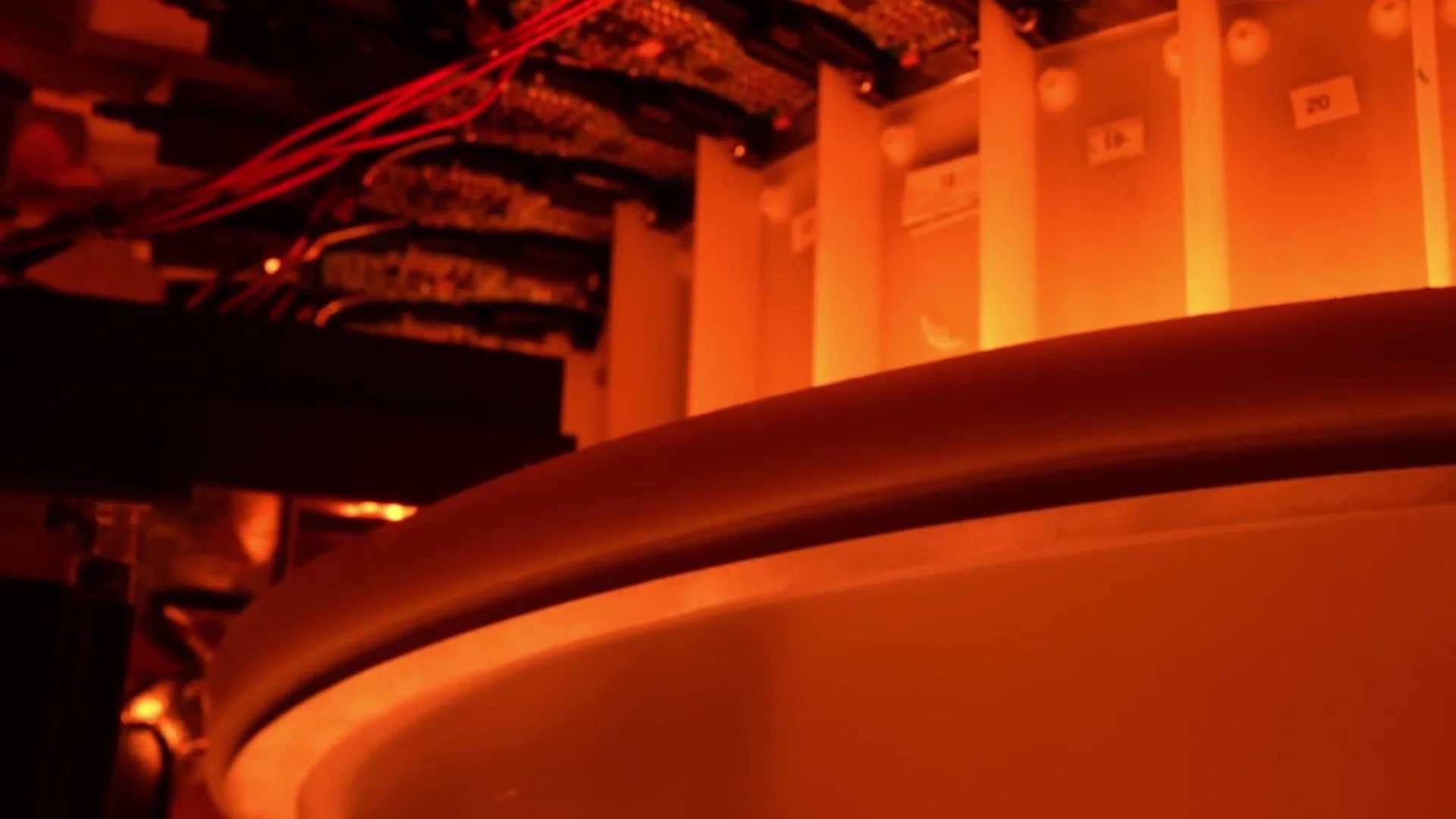
Midjourney became known for transforming text commands into images. Now, the company wants to transform sound waves into detailed maps of the human body. The project is called Midjourney Medical And its first product is an ultrasound body scanner designed to work within a spa-like experience.
The proposal draws attention: enter a shallow pool, slowly descend through a ring of sensors and receive a three-dimensional map of the body. The goal is to complete this process in approximately 60 seconds, without ionizing radiation and without the large magnets used in magnetic resonance machines.
But it is important to separate the vision from the product that exists today. The current prototype still takes more than 20 minutes per exam, initial use will be limited to body composition, and Midjourney itself says it is not suitable for diagnosing or treating disease.
This article is informative. The Midjourney Scanner is still in development and is not a substitute for examination, diagnosis, or guidance from healthcare professionals.
How this project started
Midjourney's move toward the physical world began to appear publicly in August 2024. At the time, the company announced the formation of a hardware team in San Francisco, but did not explain what product was being developed.
According to the schedule later published by Midjourney Medical, the scanner project officially began in January 2025. The choice seemed unexpected for an artificial intelligence imaging company, but founder David Holz already had experience with hardware. Prior to Midjourney, he co-founded Leap Motion, known for hand-tracking sensors.
In November 2025, the first concrete confirmation emerged that the initiative was linked to health. A document filed by Butterfly Network with the SEC, the body that regulates the United States capital markets, revealed a development and licensing agreement with Midjourney.
The contract provides for the use of the technology Ultrasound-on-Chip, which brings together ultrasound elements in semiconductors. Under the terms disclosed, Midjourney would pay $15 million initially, an annual license of $10 million during the five-year deal, and up to $9 million Butterfly estimated payments of up to $74 million over the period, not counting chip purchases and future revenue shares.
The revelation in June 2026
The secret ended on June 17, 2026. David Holz presented the new Midjourney Medical division and showed the concept of a piece of equipment called by the company Ultrasonic CT, or ultrasound computed tomography.
Despite the name, it is not a conventional tomography. The equipment does not use X-rays. It works with ultrasonic waves emitted from various angles and uses water to facilitate the transmission of sound between the sensors and the body.
Butterfly has confirmed that the current prototype incorporates 40 Ultrasound-on-Chip Modules. The final design described by Midjourney aims to bring together approximately 500,000 small elements capable of emitting waves and listening for returning echoes.
How the scanner works
The person stands on a platform and keeps his head above the water. The platform descends at a speed of approximately five centimeters per second and passes through a ring of submerged sensors.
Each sound pulse changes as it passes through tissues with different densities and stiffness, such as fat, muscles, and organs. The system registers these changes from numerous angles. Then, a large computational infrastructure tries to reconstruct the signals as three-dimensional slices and volumes.
The logic resembles a mix between ultrasound and tomography: the device collects measurements around the body and the software solves a complex mathematical problem to form the image. According to the company, the flow can generate terabytes of data per second. These numbers still need independent validation in published technical studies.
The video below, published by the Fireship channel, summarizes the scanner's proposal and the main questions about the project.
What already works and what is still a promise
The images released by Midjourney were not generated by its well-known artificial intelligence model. The company claims that they came from volunteers participating in an image-collection study analyzed by an independent committee.
The first-generation prototype was completed in January 2026. It can produce body reconstructions, but a capture still takes time more than 20 minutes. The 60-second mark is a goal for future releases, not current performance.

The company also claims that the technology could achieve details of less than one millimeter and be, in some respects, superior to magnetic resonance imaging. So far, however, no independent clinical studies have been presented that prove equivalence or superiority for diagnosis.
The equipment also does not use artificial intelligence in its current process in the way that many people might imagine when they hear the name Midjourney. The work available today depends mainly on sensors, physics, signal processing and computational reconstruction. AI appears as a future possibility to interpret and organize larger volumes of data.
The situation with the FDA
In February 2026, Midjourney filed an application with the FDA known as 513(g). This procedure allows a company to ask the agency for its opinion on the classification and regulatory requirements applicable to a device.
According to documentation published by Midjourney itself, the FDA responded on June 4, 2026 and classified the scanner as a class II device exempt from 510(k) prior notification, as long as it is offered only as a body composition analyzer.
This does not mean that the FDA has proven the product's promises. Midjourney acknowledges that the answer Not a stamp of approval. The simplest path is valid because the first version does not intend to diagnose, treat, cure or prevent diseases. If the company wants to identify tumors or offer any diagnosis, new evidence and other regulatory submissions will be required.
Why Put the Scanner in a Spa
The company doesn't want the exam to look like a hospital visit. The plan is to install the equipment in environments with heated pools, saunas, cold showers and break rooms. The first Midjourney Spa is expected to open in San Francisco in late 2027.

The bet is to turn the collection of body data into a habit. Instead of seeking an exam only when there is a suspicion, the visitor could follow changes in body composition over time.
This model also creates delicate questions. Who will have access to the body maps? How long will they be kept? How will the user be able to erase their history? Midjourney says it uses encrypted systems and access controls in surveys, but the scale imagined for the future will require clear rules for consent, security and privacy.
The Midjourney Medical Timeline
| Date | What happened |
|---|---|
| August 2024 | Midjourney announces that it is assembling a hardware team. |
| January 2025 | Official start of the scanner project, according to the company. |
| November 2025 | Butterfly and Midjourney sign the development and licensing agreement. |
| December 2025 | The location of the first spa is chosen in San Francisco. |
| January 2026 | First-generation prototype is completed. |
| February 2026 | A 513(g) application is submitted to the FDA and the first study is reviewed by an independent committee. |
| June 4, 2026 | FDA responds on regulatory framework for body composition, according to Midjourney. |
| June 17, 2026 | Midjourney Medical and the scanner are presented publicly. |
| July 2026 | Second generation project reaches the design results stage. |
| November 2026 | Goal to complete the first candidate version of the second generation. |
| August 2027 | Goal to finish verification and validation. |
| November 2027 | Goal to get the scanner ready and inaugurate the spa. |
| 2028 onwards | The company intends to take a third generation to other cities. |
| 2031 | Ambition to reach 50 thousand scanners and one billion monthly exams. |
Future dates are company goals and may change.
The risks of knowing too much
Frequent tests can help keep track of changes, but they can also find changes that would never cause problems. This type of incidental finding can cause anxiety, new tests, unnecessary procedures, and expenses.
The American College of Radiology says there isn't enough evidence yet to recommend whole-body MRI to people with no symptoms or risk factors. The observation refers to the MRI, not the Midjourney scanner, but it shows why body-tracking programs need to prove real benefit and define what to do with each finding.
There are also important physical differences between ultrasound and MRI. Bones, air, and certain regions of the body can limit the propagation of sound. Therefore, visually impressive images are not enough to confirm clinical utility.
What we know in August 2026
Midjourney Medical isn't just an idea presented on video. There's a prototype, images produced on volunteers, a multi-year contract with a medical technology manufacturer, and a formal development schedule.
Butterfly's most recent update, published on July 30, once again named Midjourney among the projects built on top of its ultrasound-on-chip platform. This confirms that the collaboration remains active.
At the same time, the commercial scanner does not yet exist. 60-second capture, comparison with MRI, expansion to diagnostics, and a worldwide network of 50,000 units remain future goals.
The project deserves attention precisely because it brings together three areas that rarely appear in the same product: medical sensors, large-scale computing, and consumer experience. If Midjourney can turn a 20-minute prototype into a reliable, affordable, and clinically useful device, it could change the way people track their own bodies. Until then, the most important part of the story will be looking at the data, not just the promises.
Sources consulted
- Midjourney Medical Announcement
- Development and Regulation Update
- Butterfly explains the technology used in the prototype
- Butterfly and Midjourney contract filed with the SEC
- Butterfly Financial Update July 2026
- FDA Guidance on 513(g) Applications
- American College of Radiology's position on body tracking
- Midjourney Hardware Team Announcement in 2024
- Fireship Channel Explainer Video