Games
Pong: The Story of the Simple Game That Helped Create an Industry
Before going down in history, Pong was just an exercise given to engineer Allan Alcorn. Learn about the role of Nolan Bushnell, Ted Dabney, Ralph Baer and Magnavox Odyssey in the game that introduced video games to millions of people.
By Ederson Andrade · August 29, 2026 · 9 min read
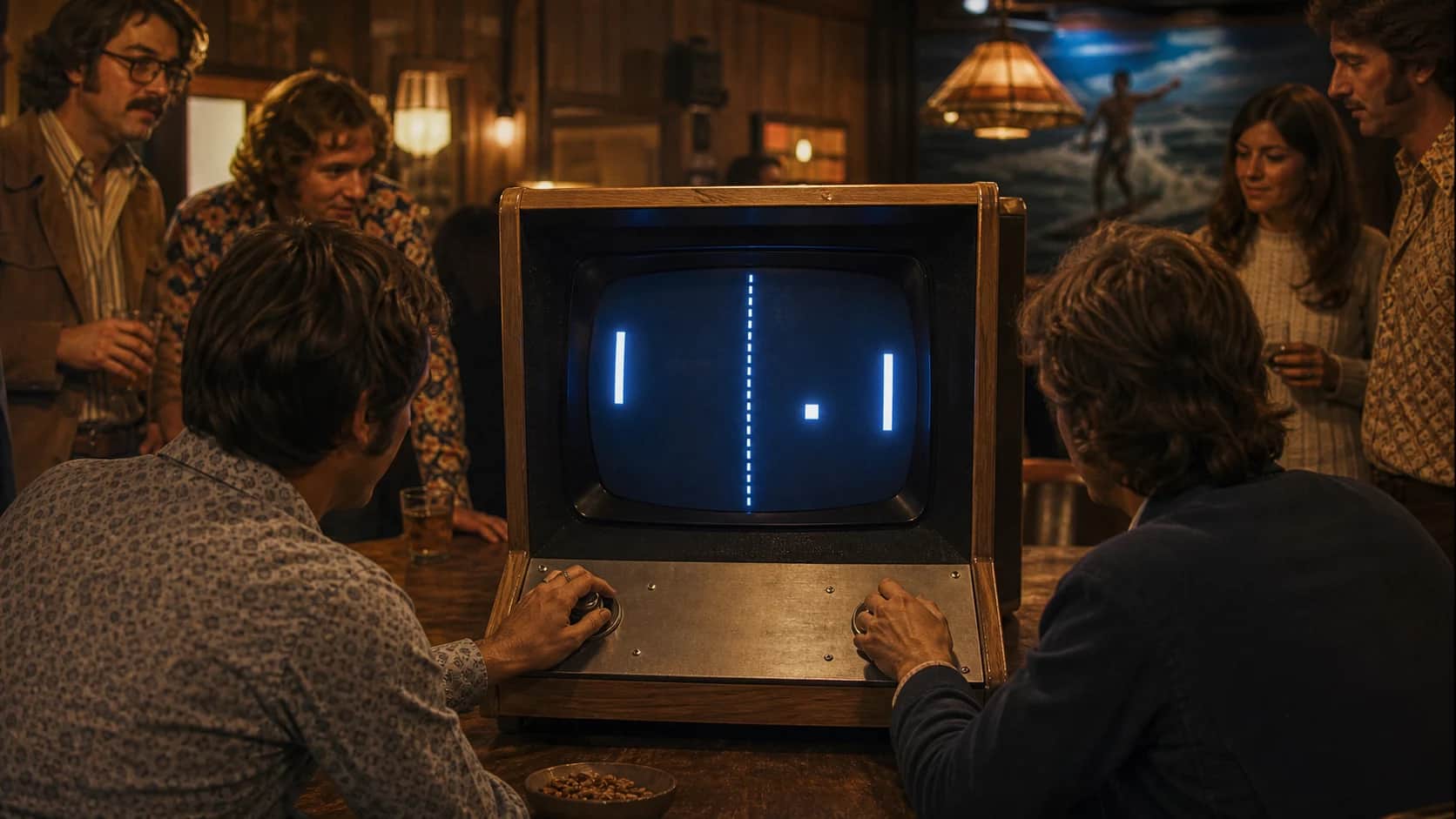
Two white bars, a square that crosses the screen and an electronic sound with each hit. Pong It seemed simple even by 1972 standards. Precisely for this reason, it helped millions of people to understand an idea that was still strange: television could also be used to play.
Pong was not the first video game in history, nor was it born without influences. Before it, there were experiments at universities, the game Spacewar!, the Computer Space machine, and the Magnavox Odyssey console. Its importance lies elsewhere. Pong transformed a technology that is difficult to explain into a diversion that anyone could understand in a few seconds.
Before Pong, video games were still looking for their audience
In the early 1960s, electronic games were mainly linked to large and expensive computers. Spacewar!, created in 1962 at MIT, became a reference among students and researchers, but it was not a product designed for bars or homes.
Nolan Bushnell saw an opportunity to bring this kind of experience to coin-operated machines. The result was Computer Space, launched in 1971 by Nutting Associates and developed with the participation of Ted Dabney. The machine had a futuristic case, but its way of playing was complex for those who encountered the device for the first time.
Computer Space did not achieve the expected success. The experience, however, taught Bushnell something decisive: an arcade video game needed to be understood quickly, before the potential player lost interest.
Ralph Baer, the Brown Box and the Magnavox Odyssey
While Bushnell was experimenting with arcade machines, the engineer Ralph Baer researched how to transform a home television into an interactive device. In 1966, he began to develop a system that would become known as Brown Box.
The project was licensed to Magnavox and gave rise to the Magnavox Odyssey, released in 1972 as the first commercial console for home use. Among his experiments was an electronic tennis game with two elements controlled by the players and a ball moving across the screen.
The Smithsonian's National Museum of American History records that Bushnell participated in a demonstration of the Odyssey in May 1972. That presentation had a direct influence on the idea that would later be transformed into Pong. Recognizing this connection is important because history does not just begin with Atari.
Atari is born
Bushnell and Ted Dabney founded Atari in June 1972. The two had previously worked together on Computer Space and wanted to build more accessible and commercially viable video games.
One of the first hires was the engineer Allan Alcorn, also called Al Alcorn. A newcomer to the company, he was given the mission to create a simple electronic tennis game. Bushnell presented the task as a training exercise for the engineer to learn how to develop an arcade machine.
What was supposed to be just a test became Atari's first major product.
Allan Alcorn turned exercise into a game
Alcorn didn't just put two bars and a ball on the screen. He worked to make the match vary and stay interesting after the first few minutes.
The rackets were divided into invisible segments. Depending on the point of contact, the ball returned at another angle. Speed increased during exchanges, making each round more difficult. Short sound effects gave immediate response when the ball touched a racket, a wall, or left the field.
All of this was built without a microprocessor and without a stored program like today's games. The logic depended on dedicated electronic circuits, assembled to perform that experience exclusively.
The prototype used a simple black-and-white television, rotary controls, and a wooden cabinet. The modest appearance hid a very efficient design decision: no one needed to read a manual to understand the point.
The test at the bar that was full of coins
The prototype was installed in the Andy Capp's Tavern, in Sunnyvale, California. A short time later, the owner of the establishment warned that the machine had stopped working.
When Alcorn went to check the defect, he found that the game had not broken. The makeshift compartment that received the coins was so full of 25-cent coins that new chips could not get in.
The story has been preserved by the Smithsonian, the Computer History Museum, and other historical collections. For small Atari, that crowded compartment served as a very convincing market research.
November 29, 1972: Pong hits the market
Atari considers November 29, 1972 the date of Pong's commercial debut. The company began to manufacture cabinets and distribute the game to bars, restaurants and entertainment spaces.
Pong did not require prior knowledge of computers. One person moved the bar on one side, another controlled the opposite bar, and both tried to prevent the ball from getting past their defense. The contest resembled table tennis, but worked in an entirely electronic space.
The success attracted competitors and dozens of imitations. Because the visual idea was straightforward and the circuit could be reproduced, similar games spread rapidly. This reduced Atari's exclusivity, but it also helped turn the video game into a recognizable commercial category.
Who created Pong?
The short answer is: Allan Alcorn designed and built Pong for Atari. But the whole story involves several people.
- Allan Alcorn He was the engineer responsible for the game, the circuit and the decisions that gave depth to the match.
- Nolan Bushnell conceived the commercial project, assigned the challenge to Alcorn and realized the potential of the prototype.
- Ted Dabney he co-founded Atari, participated in the previous stage with Computer Space and helped create the structure where Pong was developed.
- Ralph Baer led the work that originated the Magnavox Odyssey and its electronic sneaker, an earlier and documented influence.
The video below, published by the Computer History Museum, brings together Atari pioneers and helps place their work within the broader history of computing and video games.
The dispute with Magnavox
The success of Pong brought a question that would accompany the entire industry: where does the inspiration end and the infringement of a protected invention begin?
Magnavox filed a patent infringement lawsuit. The company had detailed documentation of Ralph Baer's work and was able to demonstrate that Bushnell had attended the Odyssey presentation before Pong's creation.
Instead of prolonging the dispute, Atari reached an agreement with Magnavox. The episode does not erase Alcorn's engineering work, but it prevents Pong from being told as an invention that appeared without precedent. Its originality lies both in the execution and in the ability to make that concept irresistible to the arcade audience.
1975: Pong enters homes
After its success in commercial establishments, Atari decided to bring the game to home televisions. Alcorn led the development of a version capable of concentrating the game's logic into an integrated circuit more suitable for mass production.
The partnership with the Sears chain put the Home Pong in the 1975 Christmas catalog. The device came ready to run the game and used dedicated controllers, without cartridges or software installation.
Domestic success showed that television could no longer be just a device for watching programs. It could also respond to the actions of the viewer. A few years later, consoles with cartridge games would expand this idea, including the Atari VCS itself, later known as the Atari 2600.
Why did such a simple idea work?
Pong has gathered design principles that are still present in modern games:
- Immediate Goal: Just stop the ball from going through your racket.
- Direct Control: The movement of the hands produces a clear response on the screen.
- Instant Return: Image and sound confirm each contact.
- Progressive difficulty: Speed and angle make shifts less predictable.
- Social competition: Two people share the same machine and see the same rules.
- Short games: Losing creates the desire to try again without requiring a large time commitment.
This combination made Pong work both for those who had never seen a video game and for those who wanted to master its details. It's a classic example of the expression "easy to learn and hard to master".
Pong wasn't the first, but he changed the scale
To call Pong the first video game would be to erase decades of previous experiences. What he did was different: he introduced the electronic game to a wide audience and proved that there was a sustainable business around this fun.
The success strengthened Atari, encouraged new manufacturers, increased the presence of electronic machines in public spaces, and helped prepare the domestic market. It also consolidated a visual language that is still immediately recognizable today, even by people who never touched the original cabinet.
In 2015, Pong entered the first class of the World Video Game Hall of Fame, organized by The Strong National Museum of Play. The museum highlights its longevity, reach, and cultural influence, alongside games such as Pac-Man, Tetris, Super Mario Bros., Doom, and World of Warcraft.
A square that keeps moving
More than half a century later, Pong remains present in relaunches, tributes, art installations, research, and countless variations. His appearance can be reproduced in a few elements, but his story brings together engineering, commercial vision, patent disputes, and a profound change in people's relationship with television.
Pong's greatest legacy is perhaps this: he showed that a technology doesn't have to seem complicated to be revolutionary. Sometimes, two bars and a square are enough to start an entire industry.
Now it's your turn
The Play Pong accompanies the reading in the corner of the screen. When you open it, the game appears on this page in 16 format:9. The visual starts in black and white, gains colors at point 5, receives more pixels at point 10 and enters the neon era from point 15.
On mobile, keep Climb or Descend pressed to move the paddle continuously. Your record is saved only in this browser. Music and effects can be turned off at any time.