Technology
Meta Connect 2026: the announcements that bring AI, smart glasses and virtual reality closer together
Meta Connect 2026 presented Muse in glasses, Ray-Ban Meta Audio, Gen 3 and Meta VR Glasses. See prices, dates, differences and the situation in Brazil.
By Ederson Andrade · September 26, 2026 · 9 min read
Audio
Listen to this article
11 minutes, approximately
Meta Connect 2026 made it clear which device the company wants to turn into the next big artificial intelligence interface: glasses. During the event, held on September 23 and 24, Meta presented the Muse personal agent in AI glasses, launched Ray-Ban models with and without a camera and unveiled a virtual reality device weighing approximately 100 grams.
The novelties do not form a single category. The Ray-Ban Meta Audio prioritize sound and voice commands, without a camera or screen. The third-generation Ray-Ban Meta adds a camera to record what the user sees. The Meta VR Glasses, on the other hand, cover the eyes with screens and create a virtual environment. Understanding this difference helps to evaluate what has really changed and not to treat all these products just as "smart glasses".
The main announcements of Meta Connect 2026
| Advertisement | What was confirmed | Price and forecast announced | Situation in Brazil |
|---|---|---|---|
| Muse on the goggles with AI | The agent will be able to interpret what the person is seeing and perform actions by voice | Arrival "in the coming months", no separate price informed | No confirmed date |
| Ray-Ban Meta Audio | Cameraless glasses, with open audio, microphones and access to AI | Starting at $349; shipping from October 13 | No confirmed release |
| Ray-Ban Meta (Gen 3) | 12 MP camera, 3K video, six microphones and up to nine hours of battery life | Starting at $449; immediate availability in participating markets | No confirmed release |
| Meta VR Glasses | Micro-OLED displays, eye and hand interaction, and external processing module | $1,299.99; Spring 2027 in the Northern Hemisphere | No confirmed release |
| Developer tools | SDK v207, Tools for AI-powered Glasses and Game Creation in Horizon | Part of the tools is already available | Availability varies by service |
Prices have been announced for the United States and do not include direct conversion, taxes or import costs. The Brazilian page of the event shows the products, but this, in itself, does not confirm that they will be officially sold in the country.
Muse wants to turn glasses into an interface for action
O Muse is presented by Meta as a personal AI agent. An agent differs from a question-and-answer assistant in that it can be given an objective, use connected services, and perform steps in the background. In the company's example, the person looks at a product on a shelf, a poster, or a list of school supplies and asks for an action without having to describe everything out loud.
This experience depends on the model of glasses. A device with a camera can provide visual context to the agent; an audio-only model depends on what the user says and the data available in the connected services. Meta said that Muse will gain voice mode, its own email address and connectors for shopping, travel and productivity, including PayPal, Expedia, Notion, GitHub and Box.
The potential gain is to reduce the number of steps taken on mobile. The trade-off is to give an agent access to more personal context and third-party accounts. Before activating a connector, the user will need to look at what data is shared, what actions require confirmation, and how to undo an operation. The demo shows a product direction; it doesn't yet prove that the system will respond with the same accuracy in noisy environments or in simultaneous conversations.
Meta also showed the Muse Charm, a small voice device to talk to the agent. The company promised to release more information in 2026, but did not confirm price, sale date or markets.
Ray-Ban Meta Audio eliminates the camera
Ray-Ban Meta Audio is the most direct attempt to make AI glasses less intrusive. The model has no camera or screen. It packs open speakers, microphones and access to the assistant in a 43-gram frame. According to Meta, the battery lasts up to 12 hours, while the case adds up to 48 hours of use.
The absence of a camera produces a clear exchange. The device does not photograph, does not record videos and does not allow the AI to interpret the scene in front of the user. On the other hand, it reduces the concern of those who are nearby about a possible recording. It is a proposal closer to open headphones incorporated into the glasses than to augmented reality.
The line will have 23 color and lens combinations in Clubmaster and Burbank formats. Pre-orders started in the markets advertised for $349, with shipments scheduled for October 13. Meta did not include Brazil in the initial announcement.
Ray-Ban Meta Gen 3 improves camera, audio and battery
For those who want to record photos and videos hands-free, the third generation of Ray-Ban Meta preserves the camera. The set includes a 12-megapixel sensor, 3K video recording, six microphones and a configurable action button to open Meta AI.
The announced autonomy is up to nine hours, one hour more than in the second generation. The company also claims that the new microphone array reduces more than 90% of background noise in calls and voice commands. As in previous generations, a front LED indicates when the camera is recording.
There are 27 combinations between colors and lenses in the Aviator, Zena and Wayfarer models. The initial price reported was US$ 449. Again, immediate availability means only the markets served by the company, not a confirmed sale in Brazil.
Meta VR Glasses take the weight off the face, but keeps a module in the pocket
The Meta VR Glasses were the most ambitious hardware announcement of the event. The company claims that the glasses weigh about 100 grams, approximately a fifth of the weight of the Quest 3. This reduction was possible because battery, storage and processing are in an external module connected to the glasses by an optical cable.
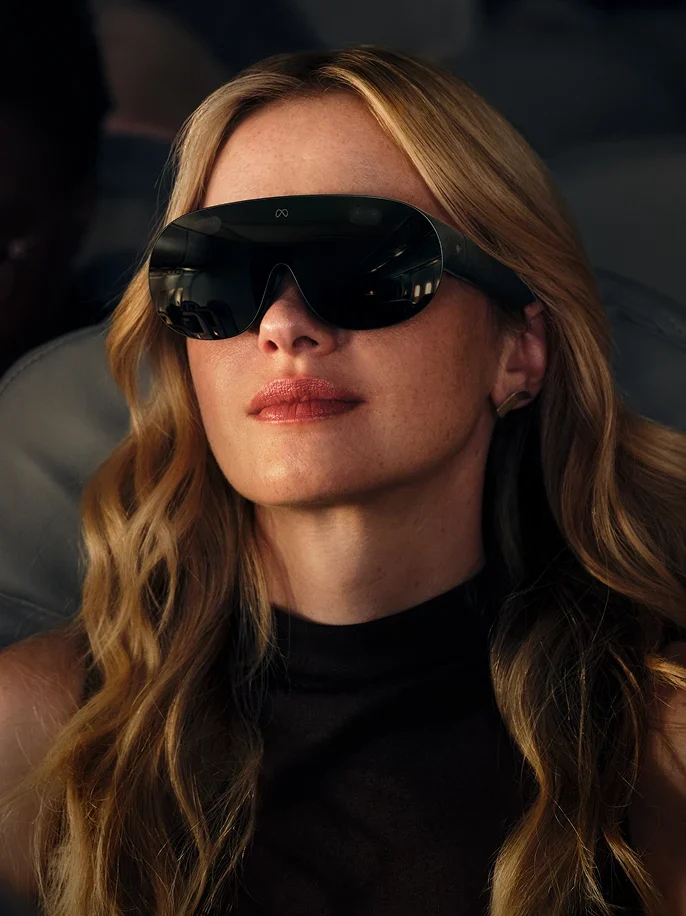
Image Source: Meta Connect 2026 official page.
The device uses micro-OLED panels, a physical resolution of 2,412 × 2,288 pixels per eye and a density of 37 pixels per degree. The nominal field of view is 70 degrees horizontally by 66 degrees vertically, lower than the 110 × 96 degrees reported for the Quest 3. In practical terms, Meta has swapped some of the visual range for a much lighter frame and a denser image.
Controls do not come with the product. Navigation combines eye tracking for pointing and a pinch gesture with the hand for selecting. Compatible controls will be sold separately. The glasses also offer color vision of the surrounding environment, a feature known as Passthrough, to blend virtual windows with the desk, phone, or other parts of the physical space.
Meta promises playback with Dolby Vision and Dolby Atmos, 3D movies, more than 100 immersive sporting events per year, and a multi-screen workspace. The external module uses the Snapdragon Reality Elite processor, supports 45W charging, and offers up to three hours of continuous high-resolution media playback.
It is necessary to read these specifications as goals released by the manufacturer. The product should only arrive in spring 2027 in the Northern Hemisphere for US$ 1,299.99. Until final units are independently tested, questions remain open about comfort for long periods, heating, tracking stability, real battery life and cable annoyance.
The new glasses do not replace the Meta Quest
The developer documentation itself describes the Meta VR Glasses as an addition to the family, and not as a replacement for the Quest. The reason appears in the design choices: the Quest maintains a wider field of view and controls suitable for games with complex movements, while the new glasses prioritize lightness, media, work, and interaction by gaze and gestures.
This distinction also explains why Meta made the v207 SDK available before hardware. Existing apps will be able to use the same Horizon OS and the same development paths in Unity, Unreal, Android, and Web, but will need to adapt buttons at the edges of the view and actions that rely on physical controls. Simulators already allow you to test the field of view and the combination between gaze and pinch gesture.
For AI glasses, the company has released version 1.0 of the Wearables Device Access Toolkit, which allows you to integrate mobile experiences with compatible sensors, and opened the development of web applications for the Meta Ray-Ban Display. The proposal is to make the glasses no longer depend only on the functions created by Meta itself.
Connect also introduced Horizon Create for mobile and Horizon Studio for browser. Both tools use natural language commands to create and tweak games that can be distributed across Facebook, Instagram, and Horizon. They lower the initial barrier, but a text command doesn't take the work out of testing gameplay, accessibility, performance, and security.
What is already known about the arrival in Brazil
Until September 26, 2026, the statements consulted did not confirm price or date for Ray-Ban Meta Audio, Ray-Ban Meta Gen 3 or Meta VR Glasses in Brazil. Meta only informed that the line called Meta Glasses It will arrive "soon" in the country, without presenting a calendar. The same text lists other markets for Ray-Ban Meta and Oakley Meta products, but does not include Brazil in this specific list.
Therefore, the presence of Portuguese pages, pre-order buttons, or dollar values should not be interpreted as a national release. Warranty, prescription lenses, AI features, languages, and connected services may also vary by region.
What Meta Connect 2026 reveals about the company's strategy
The common thread between the ads is the attempt to bring AI to a device that accompanies the user and receives context by voice, camera or eye tracking. Ray-Ban Meta Audio tests the most discreet version of this idea. Gen 3 adds computer vision and media registration. Meta VR Glasses expand the proposal to immersive screens and spatial work.
There are still three obvious obstacles: Trust, because agents and sensors handle personal data; Autonomy, because small devices rely on limited batteries; e Availability, as pricing, services, and support vary widely between countries. The event showcased engineering advancements and a broader ecosystem for developers, but much of the promised experience has yet to be proven outside of the controlled demos.
Anyone who wants to see the full presentations can access the Meta Connect 2026 official page, which brings together the keynote, the developer meetup, and the on-demand technical sessions.