Artificial Intelligence
Zeehoo AIPAL Dock: the AI assistant that wants to live at your desk
The Zeehoo AIPAL Dock combines voice, memory, screen reading, presence sensors, and charging to turn artificial intelligence into a desk companion. Understand how it works, what it promises, and what questions still need to be answered.
By Ederson Andrade · August 29, 2026 · 10 min read
Audio
Listen to this article
12 minutes, approximately
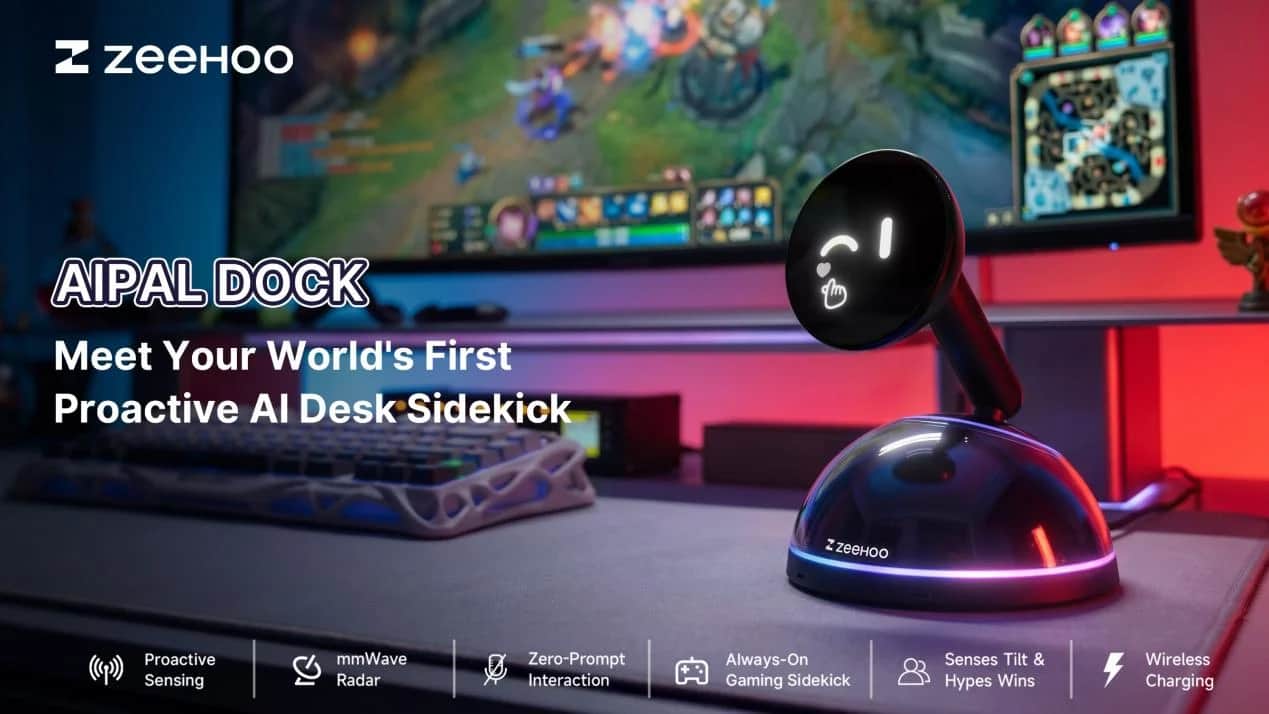
For years, talking to an artificial intelligence meant opening an app or calling a speaker for a wake word. O Zeehoo AIPAL Dock tries to change that dynamic. Instead of quietly waiting for a command, the small desktop device wants to notice when someone is approaching, follow the computer's context, and offer help at the right time.
The proposal mixes voice assistant, expressive screen, memory, reading what appears on the PC, cell phone charging and a visual personality. It's an interesting idea, but also ambitious: to be really useful, the device needs to observe part of the user's routine. Therefore, performance, privacy and transparency are as important as the nice design.
TecEdi has not yet tested a final unit. The functions described in this article come from the official material, the campaign pages and the prototype demonstrations. Where there is no independent proof yet, this will be clearly indicated.
What is AIPAL Dock
AIPAL Dock is an artificial intelligence assistant created to stay on the desk and work in tandem with a computer and mobile app. Its rounded body supports a small screen that resembles a face. It displays eyes, reactions, reminders, weather, and other at-a-glance information.
Zeehoo features three main modules in the app:
- AI Chat: voice chats, questions, research, and idea generation;
- V-Notes: recording of thoughts, classes and meetings, with transcription and summary;
- To-Do: creating tasks, reminders, and organizing the agenda.
The device can also connect to Windows and macOS computers through an add-on. According to the company, this allows you to interpret the content of the screen, summarize information and transform spoken requests into actions. In games, the promise is to recognize elements such as map, movement and interface to offer comments or alerts.
That's the central difference from a smart speaker. AIPAL doesn't just want to answer general questions. It tries to understand What's going on at that table.
From smart speakers to AI companions
AIPAL Dock is part of a sequence of attempts to give digital assistants a body of their own.
- 2014: the Amazon Echo brought a cloud-connected voice assistant into the home. The device stayed on and responded when it heard the wake word.
- 2023 and 2024: devices like Humane AI Pin and Rabbit R1 have tried to create an AI-centric hardware category, with less reliance on the traditional mobile interface.
- 2025: HP acquired the platform, patents, and part of the Humane team. The AI Pin stopped being sold and lost its connected services, showing the risk of hardware relying heavily on a startup's infrastructure.
- 2026: The AIPAL Dock has completed a Kickstarter campaign and moved on to the production and deliveries phase. Rather than trying to replace the phone, it presents itself as a permanent extension of the desk.
The choice is pragmatic. On a table there is already power, computer, screen and connection. This reduces the need to put all the intelligence inside a portable device and offers a more predictable context of use.
What it means to be "proactive"
Traditional assistants are reactive: the user asks and they answer. Zeehoo uses the word proactive because the Ultra version of the AIPAL Dock includes millimeter-wave radar, known as mmWave, to detect presence and movement near the desk.
The Pro model uses two microphones to estimate the direction of the voice. The Ultra combines the microphones with the radar to more accurately identify where the person is. The mechanism then rotates the screen towards the user, creating the impression of a face-to-face conversation.
In practice, detecting presence does not mean understanding everything someone is doing. A radar can sense approach, move away and movement without producing a conventional image, but its usefulness depends on the rules of the software. The challenge will be to provide truly timely reminders without interrupting too much or turning every movement into an attempt at interaction.


Local AI, ChatGPT, and Gemini
Zeehoo claims that the system combines local models and cloud services. Simple tasks should be processed on the connected computer whenever possible. More complex requests, current information, and heavier reasoning can be forwarded to external models, including GPT and Gemini.
This hybrid architecture has two advantages. Local processing can reduce lag and keep some of the data on the equipment itself. The cloud, on the other hand, allows you to access more powerful models without requiring a high-performance computer for all tasks.
There is also a consequence: not every function can be completely local or free. The current website shows Basic, Plus and Pro plans, while the campaign documentation mentions a monthly fee of US$ 9.90 after the promotional period. The store lists values of US$ 9.99 and US$ 19.99 for the paid tiers. As these pages are not yet fully harmonized, the buyer should check the price and usage limits presented at the time of contracting.
According to the campaign's FAQ, basic functions are still available without a subscription, while paid plans expand features and use of external services. Public details about message limits, templates included in each plan, and possible use of their own API key are still missing.
Does the device really see the screen?
AIPAL Dock does not have eyes pointed at the monitor. Reading depends on a program installed on the computer. In games and other applications, this add-on captures frames or images from the context of the screen for analysis.
The company says it doesn't continuously record a video of the screen and that analytics happens locally when the user asks a question or initiates an interaction. The campaign material also claims OBS compatibility, full-screen gaming, and borderless mode.
This can be useful for summarizing a page, turning a meeting into tasks, or explaining an element of a game. It also means granting a program access to potentially sensitive information, such as messages, documents, notifications, and work content. Before installing, it will be important to check that the application allows you to choose which programs can be read, pause the capture, and erase the history with ease.
Memory and personality
The Pro model is advertised with 32 GB of local storage, while the Ultra brings 64 GB. The memory is used for notes, recordings and preferences. The company promises that the assistant will learn the way of speaking, frequent topics and the context of previous conversations.
The screen and magnetic accessories help to give personality to the product. There are colors and props that change the appearance, while animations simulate emotions. This playful side may seem superficial, but it has a clear function: to make the user perceive the device as a constant presence, not just as a tool.
This is precisely where the product needs to avoid exaggeration. A nice animation does not mean that the system understands human emotions. AIPAL can store preferences and produce coherent responses, but it remains a software that recognizes patterns and generates language.
Privacy is the decisive point
A device with microphones, memory, presence detection, and screen access needs to accurately explain the path of each piece of data.
In the Kickstarter FAQ, Zeehoo states that screen, voice, and sensitive interactions are processed locally by default. Sending to services like OpenAI or Google would rely on explicit authorization and would be used when cloud resources are needed.
This promise is positive, but it still needs to be confirmed in the final product. The privacy policy available on the website was updated in May 2025 and mainly deals with the webshop, orders, accounts, cookies, advertising, and service providers. It does not sufficiently detail the specific data of the AIPAL Dock, such as meeting recordings, screenshots, persistent memory, retention periods, and the list of AI processors.
Research on proactive assistants shows that requests for permission at the time a piece of information is going to be used can make control more understandable. For a device like AIPAL, good controls should include:
- clear visual indication when microphone or screen reading is active;
- physical button or simple command to stop sensors and recordings;
- Choose between on-premises and cloud processing by task type;
- accessible history, export and complete deletion of data;
- information about which model received each request;
- separation between personal memory, recordings, and data used to improve the service.
Without these elements, the convenience of an always-present assistant can cost more privacy than the user imagined.
Price, campaign and delivery
The AIPAL Dock Kickstarter campaign ran between May 26 and July 7, 2026. It raised HK$126,904, approximately four times the HK$31,322 target, with 66 backers. After that, the project started accepting late orders through Indiegogo.
In the Zeehoo store, the Pro model appears from $199. During the campaign, the Ultra cost about US$ 20 more in the initial ranges. These values should not be converted into a final price promise in Brazil, as exchange rate, payment method, guarantee and eventual commercial changes can change the cost.
Deliveries are estimated for September to November 2026. As with any crowdfunding, supporting a campaign does not offer the same predictability as buying a product already available at retail. The project itself informs that deadlines may change because of manufacturing, customs or logistics.
Who AIPAL Dock Might Make Sense For
The product seems most interesting to those who spend many hours on the computer and already use AI for meetings, notes, research, creation, or games. In this situation, a dedicated device can reduce the friction of opening apps and offering reminders without taking up a permanent window on the screen.
For others, the cell phone, the computer, and a voice assistant can already fulfill most of the same tasks. AIPAL will need to prove that presence, memory, and context reading justify another piece of equipment, another account, and possibly another subscription.
There's also a question of trust. The recent history of AI hardware has shown that compelling design and great promise aren't enough. The product needs to work at launch, receive updates, and remain useful in case an external service changes its price or ceases to exist.
A good idea that still needs to prove execution
The Zeehoo AIPAL Dock points to a real trend: artificial intelligence is moving from being just a text box to occupying objects, cameras, headphones, glasses, and environments. Its desktop format seems more coherent than trying to replace the phone altogether.
The advertised functions combine productivity and personality in an interesting way. Transcribing a conversation, remembering a task, interpreting the screen, and keeping notes in the same system can be useful. But the definitive value will depend on three answers: Does the software work as well as the demos, are the privacy controls clear, and will the company be able to deliver and sustain the service?
Until independent evaluations of the final version emerge, AIPAL Dock should be treated as a promising early-stage project, not a proven solution.
Sources consulted
- Zeehoo AIPAL Dock Official Page
- AIPAL Dock Official FAQ
- Campaign ended on Kickstarter
- Technical questions answered by Zeehoo on Kickstarter
- Campaign and schedule on Indiegogo
- Zeehoo's Privacy Policy
- Amazon: Echo availability
- Rabbit: Introducing R1
- HP: Humane's acquisition of AI assets
- USENIX: Permissions in Proactive Wizards